Categories
Blogathon Favorite Classic Movies (Pre-1980)

Audrey Hepburn Blogathon–“Funny Face” (1957)

Fred and Audrey’s charming dance to ‘S Wonderful
Audrey Hepburn’s “funny face”
This is my favorite part of Audrey’s fashion show.
I love the “Clap ‘Yo Hands” number with Fred Astaire and Kay Thompson
Categories
Blogathon Favorite Classic Movies (Pre-1980) Favorite Performers

Marilyn Monroe 100th Birthday Blogathon–“Gentlemen Prefer Blondes” (1953)

A young Marilyn Monroe before she was “Marilyn Monroe”
Marilyn in the iconic “Diamonds Are a Girl’s Best Friend” number. Future Oscar-winner, George Chakiris, is in the background on the right, mouth obscured.
Jane Russell checking out the scenery in the ship’s gymnasium during the greatest musical number of all time, “Ain’t There Anyone Here for Love?”
Jane Russell imitates Marilyn Monroe
Marilyn regrets being “the goat” to Charles Coburn’s python
Marilyn Monroe and Jane Russell in the fantastic opening number, “Two Little Girls From Little Rock.”
Marilyn Monroe finds herself stuck in a porthole as George Winslow attempts to help. I Love Lucy would recreate this scene (sub Ricky and Ethel for George) in an episode of “I Love Lucy.”
Jane Russell and Marilyn Monroe in the final scene
Lucy Ricardo does her best Marilyn Monroe impression to prove she looks more like her than Ethel does. Fred Mertz thinks he looks more like Marilyn than either Lucy or Ethel!
Categories
Favorite Classic Movies (Pre-1980) Favorite Modern Movies (post-1980)

Rain in the Movies

Satsuke and sister Mei take shelter from the rain at a bus stop with Totoro keeping watch in My Neighbor Totoro (1988).
Lana Turner has a meltdown in “The Bad and the Beautiful.”
  1. The Bad and the Beautiful (1952). Lana Turner’s Georgia is distraught after discovering that her boyfriend and producer, Jonathan Shields (Kirk Douglas) has been cheating on her with a starlet. She expresses her indignation over his betrayal and he more or less tells her that he can do whatever he wants. He doesn’t owe her any loyalty, because he gave her stardom. Distraught, Georgia gets into her car and takes off on a high-speed race home, through a pouring rainstorm. Anyone who thinks Lana couldn’t act should watch her performance in this scene. She enters the car sobbing, but soon collapses into pure hysteria as the reality of Jonathan’s betrayal and callousness sets in. Juxtaposed against the frenzy of rain and flashes of lights, Georgia’s emotional collapse reaches its apex when she screams and slams on the brakes.
  2. Dead Reckoning (1947). Humphrey Bogart’s character, Rip Murdock, is investigating the death of his friend, Johnny. During his investigation, he falls in love with Coral Chandler (Lizabeth Scott). Unfortunately, he learns that Coral isn’t all she seems and was involved in his friend’s death. Coral and Rip end up in a car together after she accidentally shoots her accomplice instead of him. While Rip drives through heavy rain, he and Coral argue over her intending to kill him. She then pulls out a gun and he hits the gas pedal to floor it. Anyone who has watched a lot of old movies knows that whenever it’s raining and someone is driving recklessly, something bad is going to happen. In this film, Rip ends up crashing head-on into a tree, mortally injuring Coral.
Lucy and Desi kiss and make-up in “The Long Long Trailer.”

FAVORITE ATMOSPHERIC RAIN SCENES

Gene Kelly in what is probably the most famous rain scene of all time in Singin’ in the Rain.
Dorothy Malone watches, longingly, as Bogart departs her bookstore in “The Big Sleep.”
  1. The Big Sleep (1946). It rains constantly in this film and only lends to the overall darkness and spookiness of the proceedings. The plot is also a mess, the weather might as well be too.
  2. My Neighbor Totoro (1988). In this film, sisters Satsuke and Mei discover Totoro, a forest spirit, living near their new home. The sisters are living near a local hospital where their mother is convalescing. Totoro and his fellow spirits watch over the girls and intervene when Mei goes missing.
  3. Casablanca (1942). Humphrey Bogart’s Rick stands in the rain, eagerly awaiting Ingrid Bergman’s Ilsa’s arrival, only to be handed a “Dear John” letter. As Rick’s heart breaks, the rain washes Ilsa’s words off the page. His life is over as he knows it.
  4. Red Dust (1932). Getting caught in a monsoon forces Mary Astor’s stuffy Barbara into the home of the rugged Dennis Carson (Clark Gable). Also staying with Dennis? Vantine (Jean Harlow), a prostitute who is none too happy or impressed with Barbara’s presence. Vantine has her eye on Dennis too and does not want to share. However, upon spotting a rain soaked Barbara, Dennis is overwhelmed and seduces her. The rain in this film lends an intensity, further making an already stifling film feel even more stuffy than it did before. This isn’t a cold rain. This is a hot, humid, rain.
  5. The Old Dark House (1932). A common trope in horror or mystery films, this is another movie that uses rain to force people inside. Horror often has people seeking shelter from strangers, and they’re always unusual strangers. In this movie, Phillip and Margaret Waverton (Raymond Massey and Gloria Stuart) are driving in a heavy storm with their friend, Penderel (Melvyn Douglas). They end up seeking refuge from the Femm siblings, Horace and Rebecca. The Femms are very weird. They warn their visitors about their butler Morgan (Boris Karloff), who is mute, alcoholic, and extremely dangerous. Eventually, two more people arrive at the Femms seeking shelter, Sir William Porterhouse (Charles Laughton) and Gladys DuCane (Lillian Bond). As the group stays at the home longer, they start to discover more and more unusual people and continue to be terrorized by Morgan. This is not only suspenseful, it is also very funny. “Please pass the po-tay-toes,” is my favorite line in the film.

Categories
Blogathon Favorite Modern Movies (post-1980)

The Seventh “So Bad It’s Good” Blogathon–Xanadu (1980) & Road House (1989)

Olivia Newton-John in just one of her many costume changes in the finale in “Xanadu”
Olivia Newton-John, Gene Kelly, and Michael Beck in “Xanadu”
Olivia Newton-John and Gene Kelly in Xanadu
Gene Kelly’s amazing “glitz makeover” in Xanadu
Patrick Swayze cleans up the town in “Road House”
Patrick Swayze almost rips out someone’s throat in “Road House”
Patrick Swayze and Sam Elliott in “Road House”
Time for some eye candy! Patrick Swayze practices tai chi.
Categories
Blogathon Favorite Classic Movies (Pre-1980)

Third Annual Judy Garland Blogathon–The Harvey Girls (1946)

Judy Garland crooned this Oscar-winning Johnny Mercer standard at the beginning of The Harvey Girls, directed by George Sidney. At the start of the film, Judy’s character, Susan Bradley, is on the famed Atchinson, Topeka & Santa Fe railway enroute from Ohio to Sandrock, a small town in the American Southwest. The film takes place during the 1890s when the American west was still a bit of a wild place and train travel was the most efficient way to get across the country. Susan is traveling to Sandrock to marry her pen pal, a man by the name of HH Hartsey (Chill Wills). She has fallen in love with HH’s beautiful love letters after answering his “lonely-hearts” ad.

While on the train, Susan meets a group of young women, including Deborah (Cyd Charisse) and Alma (Virginia O’Brien) who are heading west to work at a new Harvey House restaurant that is opening in Sandrock. The head cook of the new pack of Harvey girls is Sonora Cassidy, hilariously played by Marjorie Main. It is refreshing to see Main in a fairly decent sized part and not just popping in and out of the action. She even participates in the musical numbers. The young women and Susan instantly bond when they learn of her upcoming marriage plans.

Harvey House was a real chain of restaurants that existed in the late 19th century in the United States. Fred Harvey opened his first Harvey House restaurant in 1878 in Florence, Kansas alongside the famed Atchinson, Topeka & Santa Fe railway. The chain grew rapidly with more and more locations added alongside the hundreds of miles of track that stretched from Chicago to California. Another symbol of the Harvey House, depicted in The Harvey Girls, is the employment of an all-female staff which started in 1883. The women working at these restaurants also wore a starched black and white uniform, reminiscent of a typical maid’s uniform, but more stylish. One requirement of Harvey Girls, not followed in The Harvey Girls, is the rule that prohibited women from wearing makeup while on duty.

In The Harvey Girls, the women are depicted as being proud of their employment outside the home and take pride in their appearance and in their work. The opportunity to earn money outside the home was a trait that was true for the real Harvey Girls of the 1890s. While the young women in The Harvey Girls are looking for husbands, they along with their real Harvey Girls counterparts, were able to travel, earn money, and take part in new experiences.

In The Harvey Girls, Judy Garland finds herself newly employed when her engagement falls through. It turns out that the smooth, suave, romantic HH Hartsey is actually a much older man, a curmudgeon who does not get along with the real version of Susan. HH and Susan fell in love with each other through their letters; but in person they are incompatible and ill-suited for each other. They very wisely decide to call off the wedding. Susan then learns that Ned Trent (John Hodiak), owner of the local saloon actually wrote HH’s letters. Furious, she decides to tell him off. Her feistiness and anger is nothing but a turn-on to Ned, and he spends the rest of the film pursuing her. Susan does her best to convince herself that she’s not in love with him. Then, because every film needs a love triangle, Ned’s lead saloon singer, Em (Angela Lansbury), is angry to see another woman vying for Ned’s attention. Em is in love with Ned.

To show up Ned, Susan joins the Harvey Girls to work at the Harvey House restaurant next door. This gives competition to Ned’s saloon and his associates, including Judge Purvis (Preston Foster) try their best to sabotage and run the Harvey House out of Sandrock. There’s a particularly funny scene when Judge Purvis and his friends steal all the steaks from the Harvey House. Susan enters the saloon, wielding two pistols and holds everyone at gunpoint until she gets her steaks back. Ned tries to intervene, telling Purvis that there’s room in town for both the Harvey House and the saloon, but Purvis refuses to listen.

The Harvey Girls is a lot of fun. Judy is fantastic and it’s fun to see Marjorie Main in a decent-sized role, as well as seeing Cyd Charisse in her first credited role. Cyd even gets to dance and is the girl who gets to dance in the Harvey Girl ensemble numbers. She has a sweet scene singing with her beau (or at least the beau she wants), Terry O’Halloran (Kenny Baker). Angela Lansbury is fantastic as the villain, though it’s a shame that she is dubbed in her musical numbers. She wears some fantastic looking costumes and proves to be a formidable foe against Judy–even physically. Lansbury was 5’8 and Judy was 4’11.

Judy’s co-star from The Wizard of Oz, Ray Bolger, is also in The Harvey Girls along with Virginia O’Brien to provide some comic relief. Bolger plays Chris Maule, the new blacksmith in Sandrock. He’s not very good at his new vocation, but O’Brien’s character, Alma, surprisingly is. O’Brien gets the chance to perform one of her signature stone faced musical numbers in a scene at the blacksmith shop. While I’m not particularly a fan of her schtick, it’s good that O’Brien gets her chance for a solo number. Her character all but disappears in the second half due to her real-life pregnancy. Due to filming delays caused by Judy’s attendance issues, O’Brien’s pregnancy became too advanced to hide. She was supposed to have more scenes with Bolger and have a larger role in the plot, but was more or less written out after the “Wild, Wild West” number.

The standout performance in The Harvey Girls, in my opinion, is Angela Lansbury as the bitter showgirl. This easily could have been a one-note stereotype, but Lansbury brings some depth and complexity to Em. This is a woman who is used to being the object of men’s desire, then Susan and the Harvey Girls show up. Soon, the men aren’t as interested in the gaudy, raunchy showgirls, they want the clean-cut, pure (i.e. virginal) Harvey Girls. Despite only being 20-21 when making The Harvey Girls, Lansbury’s Em seems a lot more worldly and mature than the Harvey Girls. While Em views Susan as a rival, never do I get the sense that she hates her. Through Lansbury’s facial expressions and tone, I get the sense that she is jealous and hurt that Susan and the other girls have the impression that she’s a bit trashy (i.e. a tramp) because of her look and occupation. Never once does Em do anything that would indicate that she’s a “loose woman,” this is just a quick judgement made by Susan and the other Harvey Girls. To her credit, Susan does apologize for forming such an opinion about Em which does soften her a bit.

While I typically love a relentless villain that will do anything to get their way, there is no depth too low for them to sink, Em’s redemption at the end of The Harvey Girls is satisfactory. MGM films need to have a happy ending, that’s just how it goes. The stars of the film, Judy Garland and John Hodiak, need to end up together. That’s the obvious conclusion. I know that’s how the film will end going in, it’s just a matter of getting there. Em’s character development is how the film gets there.

I can only hope that she has a happy ending in the cards as well. Maybe she’ll end up working at a Harvey House.

Categories
Blogathon Favorite Classic Movies (Pre-1980)

The Intruder Blogathon–“The Wizard of Oz” (1939)

For the this blogathon, bloggers were asked to write about movies featuring intruders. However, in this case, an intruder is not a criminal. An intruder is a person who may have entered someone’s life uninvited, but ultimately their presence lends to an improvement for everyone they meet. Often in these films, the intruder is either a supernatural being, or an alien, or simply a visitor from another town. Perhaps one of the all-time greatest films that fits this motif is The Wizard of Oz (1939).

One of the most iconic scenes in cinema history.

Because almost everyone has seen The Wizard of Oz, I don’t think an extensive plot summary is necessary. For the three people in the world who haven’t seen this film, it features a young girl, Dorothy Gale (Judy Garland) who resides on a depressing, dusty farm in Kansas. At the beginning of the film, she has a run-in with her mean neighbor, Almira Gulch (Margaret Hamilton), who claims that Dorothy’s dog Toto (Terry) bit her. Almira angrily confronts Dorothy’s guardians, her Auntie Em (Clara Blandick) and Uncle Henry (Charley Grapewin), and demands that Toto be handed over so she can have him destroyed. Henry reluctantly hands Toto over.

Because this is a happy film and having a young girl’s pet killed would be horribly depressing, Toto escapes. Auntie Em encourages Dorothy to take Toto somewhere where they can’t get into any trouble. This serves as the impetus for Judy Garland to sing what is perhaps the most famous movie song ever, “Over the Rainbow.” Later, in an effort to save Toto, Dorothy runs away. A tornado suddenly hits. Dorothy rushes back home and is unable to open the locked storm shelter. She seeks refuge in her house where she’s knocked unconscious by debris. When Dorothy awakens, she’s inside her home, but up in the cyclone. When she lands, she discovers that she is now in the Technicolor world of Oz. The scene of a sepia toned Dorothy stepping into the color saturated world of Oz is one of the most iconic scenes in film history.

The tree throwing apples at Dorothy always makes me laugh.

Soon Dorothy is greeted by Glinda, the alleged Good Witch of the North (Billie Burke). I maintain that Glinda is the true villain of the story. Glinda explains to Dorothy that she has killed the Wicked Witch of the East when her house landed, crushing the witch. The inhabitants of the land, the Munchkins (who I maintain are far creepier than the flying monkeys) rejoice and celebrate Dorothy killing the witch. Suddenly, the witch’s sister, The Wicked Witch of the West (Hamilton) appears, wanting to know who killed her sister, and to obtain possession of her sister’s ruby slippers. Glinda intervenes, placing the ruby slippers on Dorothy’s feet. Dorothy inquires about returning home and Glinda tells her only one person will be able to help her–The Wizard. The Wizard resides in the Emerald City. “Just follow the yellow brick road,” Glinda says.

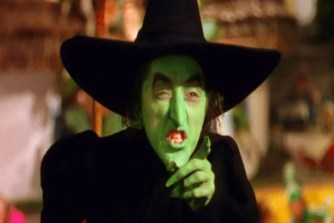
“I’ll get you my pretty, and your little dog too!” Margaret Hamilton as The Wicked Witch of the West.

While skipping down the yellow brick road, Dorothy encounters three new friends, all with their own dream. She invites each new friend to join her in her journey to the Emerald City to meet The Wizard, assuming that if he can help her, surely he can help them. The first person Dorothy encounters is The Scarecrow (Ray Bolger), who desperately wants a brain. Later, the Scarecrow and Dorothy come across a rusted Tin Man (Jack Haley). After oiling his joints, the Tin Man explains that he wants a heart. He joins Scarecrow and Dorothy. Later, the trio meet a lion in the woods. However, he’s afraid of everything, and is known as the Cowardly Lion (Bert Lahr). The lion desperately wants courage, so he can live up to his title of “King of the Forest.” Eventually they reach Emerald City and speak with The Wizard.

In The Wizard of Oz, the three main characters Dorothy encounters (Scarecrow, Tin Man, and the Cowardly Lion) are literally wasting away in Oz. The scarecrow is nailed to a post. The Tin Man is rusted, and the lion is cowering in fear. Dorothy’s determination to get to Oz to find a way back to Kansas gives them the motivation to try and achieve their dreams as well. Plus, it is easy to see that they may have also wanted to protect this young girl from the Witch while she makes this journey. Through their journey, the quartet becomes close friends and are determined to make each other’s dreams come true.

“Who rang that bell?” The gatekeeper (Frank Morgan) tries to keep the gang from seeing the Wizard.

In the third act of the film, Dorothy is kidnapped by the Wicked Witch of the West and held captive. It is up to the Scarecrow, the Tin Man, and the Cowardly Lion to save Dorothy. The three work together and come up with a plan to sneak into the Witch’s castle and find their friend. This is important as it shows (and proves the Wizard’s point) that they always had the qualities that they’re seeking and were it not for Dorothy, they would have never made this discovery. The Scarecrow uses his intellect to figure out how to save Dorothy. The Tin Man’s heart and affection for Dorothy is what motivates him to save her. The lion wasn’t cowardly at all. Because he cared about Dorothy, he summoned up the courage to break into the Witch’s castle to save his friend.

One person in the film film who isn’t helped by Dorothy’s intrusion is The Wizard, whose scam in the Emerald City is ruined by Toto. Out of guilt, he is planning to leave Oz and escort Dorothy home personally, as he too is from Kansas. Then, the Wicked Witch of the East and West definitely did not benefit from Dorothy’s intrusion. The Wicked Witch of the East was literally crushed to death by Dorothy’s intrusion. The Wicked Witch of the West was “liquidated” by Dorothy when she threw a bucket of water in the Witch’s direction, trying to save Scarecrow whose straw body was on fire. However, Dorothy melting the witch led to the salvation of the flying monkeys and the castle guards, who were literally hailing Dorothy for freeing them.

Behind that smile lurks a sociopath. Billie Burke as Glinda in The Wizard of Oz.

As for Glinda, she is the true scum of this film. Despite her fun floaty pink bubble and her billowing pink sparkly dress, Glinda sucks. First, she puts Dorothy into this dangerous situation by stealing the ruby slippers and placing them on her feet, even though legally as the next of kin, they should have gone to the Wicked Witch of the West. Then, she forces Dorothy to take some dangerous journey to the Emerald City in hopes of getting home, knowing damn well that the Wizard won’t help her. At the end of the film, Glinda tells Dorothy that she had the power to get home the entire time. When asked why she didn’t just tell her that, Glinda glibly responds, “you wouldn’t have believed me.” Dorothy was poisoned, kidnapped and nearly killed by the Wicked Witch, but yes, let’s not tell her how to get home. Thanks Glinda. She’s an intruder that leaves nothing but chaos in her wake.

“Well bust my buttons, that’s a horse of a different color!”
Categories
Blogathon Favorite Classic Movies (Pre-1980)

The Broadway Bound Blogathon–“Broadway Melody of 1940”

In 1929, MGM released the first “Broadway Melody” film. I haven’t seen this movie, but it is notable for being the first sound film to win the Oscar for Best Picture. In a story as old as time, due to the success of the first Broadway Melody film, MGM continued to release films under the ‘Broadway Melody’ banner. These films were a good vehicle for MGM to show off their musical talent, with Eleanor Powell, Jack Benny, Frances Langford and Buddy Ebsen appearing in Broadway Melody of 1936. Broadway Melody of 1938 saw the return of Powell and Ebsen, along with a teenaged Judy Garland, Robert Taylor, and George Murphy. The final film in the ‘Broadway Melody’ series was Broadway Melody of 1940. This film re-teamed Powell and Murphy, and paired them with big star, Fred Astaire, who was just coming off his successful 10-film partnership with Ginger Rogers.

George Murphy and Eleanor Powell

Broadway Melody of 1940 features Astaire and Murphy as the Broadway dance team of Johnny Brett and King Shaw, respectively. At the beginning of the film, they are performing for free in a dance hall, having been unable to book any paying gigs. One could assume they are volunteering their services in hope of being “discovered.” The non-paying venture proves to be fruitful for one part of the dance team–Johnny. Producer Bob Casey (Frank Morgan) sees Johnny’s dancing and thinks that he’d be perfect as the partner of his big Broadway star, Clare Bennett (Powell).

When Bob approaches Johnny to offer him the role, Johnny mistakes him for someone from whom he’d borrowed money. To throw off his creditor, Johnny gives King’s name instead. King ends up being offered the role of Clare’s dancing partner in her next production. The middle act of the film sees Johnny coaching the less talented King and help him learn his routines. King is very lackadaisical throughout rehearsals and is not taking his big break seriously–much to the frustration of Johnny and Clare. To make matters worse, King’s ego is out of control, leading him to drink heavily and become unreliable.

Powell and Astaire in another brilliant number.

Intermingled with the main plot are two specialty numbers. The first one, aka “the good one,” features famous juggler Trixie Firschke. She is fantastic. She effortlessly juggles plates, balls, balances a ball on a mouthstick, and even bounces a ball on her head while juggling. It is truly mesmerizing to watch. Then there’s the other specialty act, aka “one of the most excruciating and annoying things I’ve ever seen.” The horrible specialty act features Charlotte Arren auditioning to be an opera singer. Researching Arren, I learned that she was a vaudeville performer and her horrendous opera singer audition was her schtick. She was acting this way on purpose. This scene is so irritating, I fast forward through it. Give me Jules Munshin pantomiming how to make a niçoise salad, any day–just to give you an idea of how annoying this act is. Give me Gene Kelly and Phil Silvers’ obnoxious “Heavenly Music” number (that I consider one of the worst musical numbers of all time). I would rather watch both of those routines back-to-back than ever see Arren’s “Audition” routine again. I cannot imagine paying to watch a vaudeville show and having to see/hear this. I’d definitely need to have my basket of produce ready for throwing.

Eleanor Powell and Fred Astaire in one of the more gorgeous musical numbers ever, “Begin the Beguine.”

Eventually, as one can suspect, something happens in the plot that allows Fred Astaire and Eleanor Powell dance together. If it didn’t, what would be the point of this movie? Fred and Eleanor appear in the last act on a gorgeous all black, highly reflective set. They look like they’re floating in space. Juxtaposed against the black set are Fred and Eleanor in all white. It makes for a very striking scene. Their tap work is exquisite, as is the final number, “Begin the Beguine.” This is hands down one of the best musical routines ever committed to film. Fred said that Eleanor was the only partner he was intimidated by, because she was so good. It definitely shows in this routine, she matches him step for step and the routine is absolutely flawless and impressive.

George Murphy’s dancing is fine, and maybe in another film, he would have been a standout. But Broadway Melody of 1940, he is the third best dancer in the film. He’s just there to lend a little conflict to the film, but this is Astaire and Powell’s film the entire way. Broadway Melody of 1940 has a fairly pedestrian plot, but the musical numbers more than make up for it. The entire closing number, all six minutes of it, is one of the highlights of the musical film genre. I would recommend this film, if only for the “Begin the Beguine” number.

Categories
Blogathon Favorite Classic Movies (Pre-1980)

The “Take Two” Blogathon- High Society (1956)

On April 19th in 1956, Grace Kelly married Prince Rainier the sovereign ruler of Monaco. Grace had met Prince Rainier a little less than a year prior, in May of 1955. By saying “I do,” Grace gave up her successful, Oscar-winning Hollywood career and assumed her duties as Princess Grace of Monaco. She didn’t plan to give up her career after the wedding, but was pressured to do so by her new husband. As a result, the last film that Grace made was High Society, a musical remake of The Philadelphia Story.

Poor Celeste Holm, a fellow Oscar-winner to a cast full of Oscar-winners and she’s left off the poster.

The Philadelphia Story was released in 1940 and was the film that saved Katharine Hepburn’s career. In the original film, Hepburn plays Tracy Lord, an affluent young woman who is marrying for the second time to George Kittredge (John Howard). Tracy is part of the Philadelphia upper-crust. Her first husband, C.K. Dexter Haven (Cary Grant) re-enters her life after arranging for Spy Magazine to cover Tracy’s wedding. Two years prior, Tracy had divorced C.K. due to him not meeting the impossible standards that Tracy sets for her friends and family. She also thought he drank too much and her critical opinion of his drinking caused him to imbibe even more.

On the same day, Macaulay “Mike” Connor (James Stewart) and Elizabeth “Liz” Imbrie (Ruth Hussey) a reporter and photographer, respectively for Spy Magazine arrive at the Lord estate. They are planning on covering Tracy’s wedding for their magazine. Complications ensue when Mike starts falling in love with Tracy, much to Liz’s chagrin. Liz harbors an unrequited crush on Mike. Meanwhile, Tracy is irritated with her ex-husband, C.K.’s constant presence. However, he helps her to realize that she needs to relax and stop being so judgemental of the people in her life. She is not perfect herself, so it is unfair to hold others to such a high standard.

Frank Sinatra and Celeste Holm in High Society

In the musical remake of High Society, the action is moved from Philadelphia to Newport, Rhode Island. Grace Kelly assumes the role of Tracy and plays the role very well. She plays a haughty socialite just as well as Katharine Hepburn. Both women have a similar way of speaking, with a very pronounced mid-Atlantic accent. Interestingly enough, Grace herself is from Philadelphia and hails from the very same world depicted in The Philadelphia Story. However, I think I prefer the shift to the Newport locale. I love that the famous Newport Jazz Festival is used as a backdrop for High Society. The jazz music is also an excellent addition to the story, as Bing Crosby stars as C.K. Dexter Haven, Cary Grant’s role from the original film. Throughout the film, C.K. is busy organizing the festival, with Louis Armstrong and his band serving as the Greek chorus for the events in this film. C.K. also happens to live next door to the Lord estate, making his constant presence believable.

Not the planned wedding, but a good ending and we get to see Tracy’s gorgeous wedding dress! Let’s hope second time’s a charm for these crazy kids.

In High Society, it is Tracy’s father, Seth Lord, who has invited Spy Magazine to cover his daughter’s nuptials. The magazine has obtained some unflattering details about Seth’s various infidelities. Seth makes a bargain with Spy Magazine and allows them to send over a couple employees to cover the wedding. Mike Connor (Frank Sinatra) and Liz Imbrie (Celeste Holm), a reporter and photographer respectively, arrive and are invited to stay at the Lords’ home. The scene where Mike and Liz arrive plays out in a similar fashion in both High Society and The Philadelphia Story. Tracy resents their intrusion and carries out an elaborate farce, including speaking French with her little sister and having her sister make an entrance dancing en pointe and then performing a song while playing piano. For her part, Tracy acts like a complete ditz, figuring that she needs to fit the image that the tabloids have of her. For the record, I find Virginia Weidler’s “Dinah” really annoying in The Philadelphia Story and prefer Lydia Reed as little sister, “Caroline,” in High Society. Weidler is the more talented performer, but there’s just something about her that makes me want to smack her.

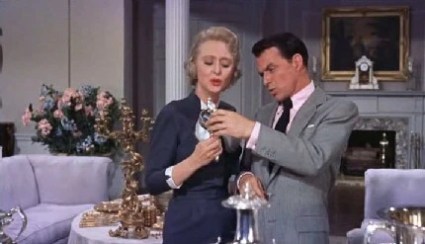
Liz and Mike admire one of Tracy’s millions of wedding gifts

What I love about High Society is that there are more scenes between Tracy and C.K., giving us an idea as to why they fell in love in the first place. The Philadelphia Story hints at that, such as when C.K. gifts Tracy a miniature replica of their yacht, “True Love,” that they sailed around in during their honeymoon. In High Society, not only does C.K. gift Tracy the miniature replica of the “True Love,” but we’re treated to a flashback sequence of C.K. and Tracy singing “True Love” on their boat. I love any singing scene that involves characters playing a small accordion. This was also a fun scene where we actually hear Grace singing with her own voice. Thank goodness they did not dub her with someone like Marni Nixon. Don’t get me wrong, Ms. Nixon was an excellent singer, but her voice is so out of place in so many of the films where it is heard (case in point, Natalie Wood’s voice in West Side Story and Audrey Hepburn’s in My Fair Lady).

Grace Kelly wears this amazing dress in High Society

I also love Grace Kelly’s costumes in this film. Her costumes are gorgeous, especially the blue chiffon dress with silver embroidery she wears during the party Tracy holds on the eve of her wedding. Katharine Hepburn’s dress in the same part of the film is incredible, but I think Grace has the edge. Grace also gets to wear a much better wedding dress during the film’s finale. I am not a fan of Katharine’s gown with the big girdle like thing across her waist. At the beginning of the film, Grace wears a simple beige blouse with beige slacks and red flats and she looks amazing. The woman could wear a stained sweatsuit and look fabulous.

One of the highlights of High Society is the duet between Frank Sinatra and Bing Crosby. This scene replaces the drunk scene between James Stewart and Cary Grant in The Philadelphia Story. The original scene is very funny, as Mike cannot stop hiccuping as he talks to C.K. However, with both Sinatra and Crosby in the cast, it is a no-brainer that a duet between the two men would have to take place. Sinatra and Crosby were often pitted against one another, with Sinatra being viewed as the crooner who would take the elder Crosby’s place. However, nothing could be further from the truth and the two men were lifelong friends. Their duet, “Well, Did You Evah!” is one of the highlights of the film.

Bing Crosby and Louis Armstrong duet in High Society

It would also be remiss of me to not mention the amazing Louis Armstrong. He and his band serve as the Greek chorus, setting the scene for the film and then commenting on the action throughout. He provides a fun presence to the action and of course, since he’s performing at the Newport Jazz Festival, which is being planned by C.K., we are treated to a wonderful performance by Louis and Bing Crosby. The two men perform “Now You Has Jazz” and it is amazing. I would have loved if Louis Armstrong and his band had been hired as the entertainment at Tracy’s party on the eve of her wedding.

Tracy and C.K. spar in front of Tracy’s fiance, drip George Kittredge.

The ending of High Society plays out exactly the same as it does in The Philadelphia Story, the dialogue is almost repeated word-for-word. However, for whatever reason I find Tracy and C.K.’s quick decision to remarry more believable in High Society, even if I’m not totally sure on the coupling of Grace Kelly and Bing Crosby. However, the two actors did date in real life, so I guess it is plausible!

While The Philadelphia Story is regarded as the “better” film, I have perhaps the controversial opinion that I find High Society more entertaining. I love the casts of both films equally. I do enjoy The Philadelphia Story, at one point owning four copies. However, given the choice between the two, I would watch High Society. The jazz music and more “fun” feel make the film for me. I love all the Bing and Sinatra performances. Louis Armstrong is amazing. Grace Kelly is gorgeous. I just love it. It was amazing to see High Society in the theater last year.

(Singing)
MIKE: Have you heard that Mimsie Starr
C.K. Oh, what now?
MIKE: She got pinched in the Astor bar
C.K. Sauced again, eh?
MIKE: She was stoned
C.K. Well, did you ever?

Frank Sinatra as “Mike Connor” and Bing Crosby as “C.K. Dexter Haven” performing “Did You Evah?” written by Cole Porter in High Society (1956).
Categories
Blogathon Favorite Classic Movies (Pre-1980)

Third Annual Esther Williams Blogathon–Dangerous When Wet (1953)

I first saw Dangerous When Wet last year when TCM featured Esther Williams during their annual Summer Under the Stars programming event. The entirety of August 8, 2021 was devoted to Esther in honor of her centennial. This was the first film that I’d seen that featured Fernando Lamas. Lamas is someone who I only knew about from his appearance as himself in an episode of The Lucy-Desi Comedy Hour, “Lucy Goes to Sun Valley.” I didn’t even know what films Lamas had appeared in and assumed he was just one of those stars who was big at the time (1958). I think that is a fair assessment. Today, if Lamas is known for anything, it’s for being the father of Renegade star Lorenzo Lamas and being married to Esther Williams.

I, however, remember Lamas for being hot hot, especially in his episode of The Lucy-Desi Comedy Hour and Dangerous When Wet!

While Dangerous When Wet was being cast, numerous leading men were suggested to partner with Esther. One of the qualities an Esther Williams-leading man needed to have was an ability to swim. Many of Esther’s leading men like Howard Keel or Peter Lawford weren’t the strongest of swimmers. To keep them afloat during filming, Esther would have to stealthily prop them up with her hand or foot while they swam. When Fernando Lamas was suggested for Dangerous When Wet, it was different. Lamas, however, was a champion swimmer from South America. Finally, Esther had a co-star who could keep up with her in the pool. She later said that it was a nice change to be paired up with someone who actually possessed real swimming ability. Lamas’ casting allowed for more rigorous swimming scenes to be included in the film. Esther must have enjoyed working with Lamas–the two would eventually marry and be together until Lamas’ passing in 1982.

Dangerous When Wet opens with the Higgins family marching out of their house while singing “I Got Out of the Bed on the Right Side” while they make their way to the nearby swimming hole for their morning ritual of calisthenics and swimming laps. Esther plays Katie, the daughter of “Ma” and “Pa” Higgins (Charlotte Greenwood and William Demarest). I recognized Greenwood from her appearances in two Betty Grable films, “Moon Over Miami” and “Down Argentine Way.” Demarest is probably best known as “Uncle Charlie” from My Three Sons, but to me, I know of him because he’s in every film ever made. Both Greenwood and Demarest have very small roles in this film. This opening number is very charming. We see Katie who is more interested in a book about dairy farming than she is in swimming. However, since it’s Esther Williams, she is swimming by the end of the scene.

Windy (Jack Carson) has his sights set on Katie (Esther Williams)

One day, traveling salesman Windy Weebe (Jack Carson) comes through town hawking his special elixir, Liquapep. Supposedly, Liquapep is a tonic that is supposed to make someone super peppy and fit. Windy is also instantly smitten with Katie. It also comes out that the Higgins family’s dairy farm is also in trouble. They need a bull to keep the farm running, however they cannot afford it. Because of his fondness for Katie and seeing a chance to promote Liquapep, Windy suggests that the family enter a contest to swim the English Channel. The cash prize would give the family enough money to buy the bull. Swimming the channel isn’t hard, it’s only 20 miles (more like 42 with the currents) across. No problem, right?

I can think of worst things than to be carried by Fernando Lamas

The Higgins family decides that Katie is the strongest swimmer in the family (obviously, because it’s Esther Williams) and their best chance to win the prize. Windy offers to coach her. One foggy afternoon, Windy loses sight of Katie during their practice. Katie becomes disoriented in the fog and but soon finds a rowboat, similar to Windy’s. She quickly discovers that the rowboat is not being captained by Windy, but rather by hot Frenchman, Andre Lanet (Fernando Lamas), a French champagne salesman. It seems that Andre is on his way back to his yacht. He also becomes smitten with Katie. Soon he finds herself in a love triangle between Andre and Windy. Gosh, who to pick?

Andre and Katie’s romance heats up as the impending swim across the Channel draws nearer.

This is a funny sequence when Esther is grabbed by an amorous octopus (voiced by Fernando Lamas)

Dangerous When Wet features a fantastic animated sequence between Esther Williams and Tom and Jerry. This is the second musical number I’ve seen with Tom and Jerry. Fans of classic movie musicals will remember that Gene Kelly danced with the duo in 1945’s Anchors Aweigh. Fernando Lamas has a funny appearance in the animated sequence as an amorous octopus. Fernando’s octopus performs a reprise of his “In My Wildest Dreams” number that he serenades Esther with earlier in the film. Fernando Lamas sings in this movie. I had no idea he was a singer and he does a great job!

There is a funny scene where Andre gifts Katie a tiny white and red polka dot bikini. She jokes about how small it is before going into her room to try it on. She breaks the fourth wall as she pulls a shade down to shield the audience’s prying eyes. We never do see what Katie looks like in that bikini. I’m sure she looked great. Later, Katie wears a great one-piece bathing suit that is made of black lace. This is the suit she wears during the swimming duet between herself and Andre. The duet takes place after Katie get a little tipsy drinking Liquipep on a picnic with Andre. To sober her up, Andre invites Katie for a nighttime swim.

Katie relaxes in an intertube during a romantic night time swim, but is soon in for a rude surprise.

The swimming duet is really fun to watch as Esther and Fernando are really swimming and going for it. Fernando did not like it when Esther would swim faster than he did, so even in the film, he’s trying to swim faster than her. The duo perform laps and swim the backstroke while flirting with each other and falling more and more in love. Katie and Andre’s love for one another is never more evident than it is in the climactic race scene at the end of the film. The end scene was based on a real-life event that happened when Johnny “Tarzan” Weissmuller dived into the water to help his student, Florence Chadwick (the first woman to swim across the English Channel), complete her race when she started to falter. Weissmuller was also Esther’s Aquacade swimming partner before she started appearing in films.

I very much enjoyed Dangerous When Wet. It’s one of my favorite Esther Williams films and Fernando Lamas strips to his skivvies at the end and I’m here for that scene. I also just discovered that my DVD has a flaw it in that causes the film to permanently pause right before the Tom and Jerry number. This is unacceptable and I’m shopping for a replacement copy.

Tom and Jerry swim with Esther Williams
Categories
Blogathon Favorite Classic Movies (Pre-1980)

Singin’ in the Rain Blogathon- Songs of Singin’ in the Rain

Singin’ in the Rain is celebrating its 70th Anniversary this year. It is widely considered to be one of the best (if not the best) musicals of all time. I have seen this movie a million times. I’ve seen it in the theater multiple times. I own the huge box set. I love this movie. While it might be a cliche answer, considering its popularity, Singin’ in the Rain is my favorite musical. At the time the film came out however, it wasn’t thought to be anything special. It did turn a profit, but nothing remarkable. Even the origin of the film came from humble beginnings.

Don and Kathy eventually star in “Singin in the Rain” for Monumental Pictures

Arthur Freed, head of the “Freed Unit” and in charge of MGM’s musicals, wanted to develop a film based around the catalog of songs written by himself and composer Nacio Herb Brown. The only original songs written in 1952 for Singin’ in the Rain, were “Moses Supposes” and “Make ‘Em Laugh.” It is pretty clear however, that “Make ‘Em Laugh” is a rip-off of Cole Porter’s “Be a Clown.” There’s a pretty funny anecdote involving Freed showing Porter around the set during the production of Singin’ in the Rain. The cast and crew were rehearsing Donald O’Connor’s memorable “Make ‘Em Laugh” routine. Cole Porter heard the music and said “isn’t that ‘Be a Clown?'” Freed distracted Porter from the song before answering.

Gene Kelly performs the title song, “Singin’ in the Rain.”

The most memorable song in Singin’ in the Rain is the title song, “Singin’ in the Rain,” featuring Gene Kelly’s character, Don Lockwood, doing what else? Singing in the rain. Kelly’s song and dance in the rain is iconic and one of the most indelible scenes of Classic Hollywood cinema. In the musical number, Don is overjoyed after coming up with a plan to save his movie career and falling in love with Kathy Selden, played by the adorable and hugely talented Debbie Reynolds. There are some urban legends surrounding Kelly’s performance of the big title song dance number. One urban legend is that the water is actually milk, with the idea that milk would be more visible on screen. Co-Director Stanley Donen (Kelly was the other director), debunked this myth. One story that is true however, is that Gene Kelly was suffering from a horrible fever during production of his big dance number. It’s amazing that he was able to perform it so well and effortlessly, despite being so sick.

Gene Kelly, Debbie Reynolds and Donald O’Connor sing “Good Morning” in Singin’ in the Rain.

“Singin’ in the Rain” was first heard in 1929, in the film Hollywood Revue of 1929. The song was performed by Cliff Edwards, who is best remembered now as the voice of Jiminy Cricket in Disney’s Pinocchio. Edwards is seen wearing a raincoat and hat, while warbling this song in the rain. It was a big hit in its day, but Gene Kelly definitely added some life to the song in 1952. Another song from Singin’ in the Rain that was recycled, was “Good Morning.” In the 1952 film, Debbie Reynolds, Donald O’Connor, and Gene Kelly sing the song after they realize that it’s past midnight after a disastrous film premiere. This song leads into Cosmo’s (O’Connor) brainstorm–turning Don and Lina Lamont’s (Jean Hagen) film, The Dueling Cavalier, into a musical. Judy Garland was heard singing “Good Morning” in her 1939 film with Mickey Rooney, Babes in Arms.

Donald O’Connor and Gene Kelly harass the poor elocution teacher in “Moses Supposes.”

After it is decided to transition The Dueling Cavalier into a musical, Don and Lina are ordered to attend elocution classes. Miss Lina “And I Can Stan’ it!” Lamont definitely needs all the help she can get. Don, on the other hand, speaks fine, but is forced to go through these classes as well. We see him learning how to pronounce his “A” vowel sounds and say tongue twisters like “Chester chooses chestnuts, cheddar cheese with chewy chives. He chews them and he chooses them. He chooses them and he chews them, those chestnuts, cheddar cheese and chives in cheery charming chunks.” Cosmo shows up he and Don and end up singing “Moses Supposes” with a lot of rhymes. This number is used as a showcase for Gene Kelly and Donald O’Connor, but you cannot help but feel sorry for the poor elocution teacher. “Moses Supposes” was one of the original songs written for the film.

Debbie Reynolds is front and center in “All I Do is Dream of You” in this adorable number.

After dropping Don Lockwood off at a Hollywood party, Kathy Selden (Reynolds) makes her big splash in Singin’ in the Rain with her adorable performance in “All I Do is Dream of You.” Kathy and a chorus line of girls are seen in cute pink outfits while doing the Charleston amidst a storm of confetti. Don is instantly smitten with her, and so is my husband. My husband finds Debbie absolutely adorable in this number. My favorite part of “All I Do is Dream of You” is when Debbie so effortlessly removes a piece of confetti from her face. Whether that was scripted, I don’t know, but she made it look so easy. What an amazing lead role film debut for Debbie. She was so talented. “All I Do is Dream of You” can be heard as an instrumental song in the Marx Brothers’ A Night at the Opera.

After Kathy sings “All I Do is Dream of You,” she unfortunately ends up hitting Lina in the face with a pie that she intended for Don. She runs out of the party in embarrassment. Lina reciprocates by having her fired. Don looks in vain for Kathy, but doesn’t have any luck. Eventually, Cosmo ends up performing a very acrobatic rendition of “Make ‘Em Laugh” in an attempt to cheer Don up. Let’s face it, this song is “Be a Clown.” There is no mistaking that. However, for all intents and purposes, it’s “Make ‘Em Laugh” in Singin in the Rain. Donald O’Connor’s solo dance is absolutely fantastic. I don’t know any other dancer(s), except for maybe The Nicholas Brothers, who could have performed the acrobatics required of this dance number. O’Connor is amazing.

If there’s one thing I love, it’s a random fashion show inserted into a film.

One of my absolute favorite things in a Classic Hollywood film is the random fashion show. Singin’ in the Rain does not disappoint and features a fashion show in the middle of the film during the “Beautiful Girl” montage. This section of the film is kind of random. My husband doesn’t like it because he feels like it is disjointed from the rest of the film. Me on the other hand, enjoy it because it features a fashion show and this section also serves as a way to get Don back with Kathy when we discover that Kathy is now working as a chorus girl in this musical number on an unnamed film. Singin’ in the Rain very effortlessly segues from the musical interlude to the story involving Kathy and Don. The other purpose that this section serves is that it shows how Monument Studios has had to adapt in face of the burgeoning technology of “talking pictures.” Now they’re producing musicals–a genre that wouldn’t have been possible during the silent era.

The “Beautiful Girl” montage opens with a mash-up of “I’ve Got a Feelin’ You’re Foolin,” “The Wedding of the Painted Doll,” and “Should I?” Images of flappers, women dressed as toy soldiers, and a man with a megaphone are seen. “I’ve Got a Feelin’ You’re Foolin'” debuted in 1936 in Broadway Melody of 1936. “The Wedding of the Painted Doll” was heard in another ‘Broadway Melody’ film, Broadway Melody of 1929. Finally “Should I?” was heard in Lord Byron of Broadway in 1930. The montage transitions into a man singing “Beautiful Girl” which was heard in the film Stage Mother in 1933. Kathy Selden is one of the chorus girls in the “Beautiful Girl” number. This scene then switches into an amazing fashion show–one of my favorite random fashion shows in film.

Cyd Charisse and Gene Kelly in my favorite number from Singin’ in the Rain.

The ‘Broadway Melody’ films provided a lot of music to Singin’ in the Rain. In the big closing number, Broadway Melody is presented as the imagination of Cosmo Brown and Don Lockwood as they pitch the revamped version of The Dueling Cavalier to Monument Pictures Studio head, RF Simpson (Millard Mitchell). The big “Broadway Melody” number was featured in Broadway Melody of 1929 along with “The Wedding of the Painted Doll.” “Broadway Rhythm” was also featured in 1936, in Broadway Melody of 1936, along with “I’ve Got a Feelin’ You’re Foolin’.” I love this part of the film. Cyd Charisse as the flapper in that green, fringed dress is gorgeous. She and Gene together are sizzling hot. This is one of the sexier dance numbers during the Golden Age of Hollywood. I love the music. Charisse is seen later wearing a white version of the same dress and later, a white dress with her own hair, and an enormous, flowing white veil. This is a very dramatic number set to an original song, the “Broadway Ballet,” composed by Nacio Herb Brown. This number is fantastic and I love it.

In the Classic Hollywood era, it is easy to find costumes and songs recycled from other previous films. If you have a great costume, or a great piece of music, why not re-use it? Singin’ in the Rain is proof that you don’t have to develop an entire catalog of new songs if you have songs that will suit the purposes of the film. However, the caveat to this is that you have to have writers that are talented. Props have to be given to the writing team of Adolph Green and Betty Comden. They were given a stack of songs and told to write a story using these songs, and boy did they deliver!

LINA: I’m a shimmering, glowing star in the cinema firmament.

Jean Hagen as “Lina Lamont” in Singin in the Rain (1952)

No! No! No!
Yes! Yes! Yes!
No! No! Nooooooooooo!