This evening, The Hollywood Reporter broke the sad news that Ann Blyth passed away yesterday, Wednesday, June 24, at the age of 98. Some other sources had her age at 97. Regardless, Blyth was one of the last stars of the Classic Hollywood era, and earliest surviving nominee of the Best Supporting Actress Oscar. She was nominated in 1945 for her performance as my favorite character and villain, Veda Pierce, in Mildred Pierce. For the record, I think that Blyth was robbed and should have won.
Ann Blyth was 16/17 years old (based on whether she was born in 1927 or 1928) when she landed the role of Veda, the teenaged daughter of Joan Crawford’s character, the titular Mildred Pierce. Mildred is determined to give her daughters (Veda and Kay) the finest things in life, much to the chagrin of her husband Bert (Bruce Bennett). In fact, Mildred’s extreme devotion to making sure her daughters, especially Veda, get everything they desire is what drives her and Bert apart and leads to their divorce. Veda is overly focused on money and appearances, and only wants what she thinks she deserves. Mildred reinforces Veda’s shallowness by constantly getting her what she wants. When Kay tragically dies of pneumonia, Mildred’s resolve to win Veda’s love through material objects only intensifies. To put it succinctly, Veda is a spoiled brat.

However, Veda’s extreme fixation on money and appearances is exactly why I love her. This is a girl who knows what she wants and she’s unrelenting about getting it. She will not settle for less. She also drops random French phrases here and there, just to seem higher class than Mildred. Veda is a complicated character who thinks she deserves to be given everything in the world, but has no intention on earning it. While she acts like she’s above it all, she’s also very immature. Using random French phrases to assert herself as “better than” the working class Mildred, is something that a child would do to show off the new language they’ve learned. There is nothing Veda won’t do for money, no matter what terrible thing she has to do to get it. At one point in the film, she marries a wealthy young man and his mother doesn’t approve. She uses this as an opportunity to fleece $10,000 ($186k in 2026) from the family by feigning a pregnancy and using the services of family friend/lawyer Wally Fay (Jack Carson) to help with the extortion. I love a real villain who is a nasty piece of work until the bitter end.
VEDA to MILDRED ABOUT TAKING UP SMOKING TO USE A CIGARETTE CASE MONTE GAVE HER: And I couldn’t hurt him by not using it. I mean, that would have been dreadfully recherche, n’est-ce pas?

Ann Blyth’s performance as Veda is truly spectacular as she’s able to imbue Veda with charm and moments of kindness and compassion, that it makes her true character even more jarring when it emerges. Her character also ages a few years during the film, and she very skillfully portrays her character maturing. At the start of the film, she’s a teenager, seeming somewhat innocent and childlike. By the end of the film, she is a legal adult and suddenly seems a lot more mature, albeit still dropping French phrases in her vernacular to seem more cultured and sophisticated. Blyth’s portrayal of Veda’s slowly emerging greed, selfishness, and shallowness is very well done. The audience only gets glimpses of her true nature when Veda makes an off-hand comment here and there or does something offscreen, such as having their housekeeper wear Mildred’s restaurant uniform while working. When Mildred reveals to Veda that she works as a waitress, Blyth’s warm expression quickly transforms into a look of anger and shame, with a narrowing of her eyes, and the tone of her voice changes from honey to poison as Veda reveals her feelings about her mother holding a working class job.
VEDA to MILDRED: You think just because you made a little money you can get a new hairdo and some expensive clothes and turn yourself into a lady. But you can’t, because you’ll never be anything but a common frump whose father lived over a grocery store and whose mother took in washing.
VEDA to MILDRED: With this money I can get away from you. From you and your chickens and your pies and your kitchens and everything that smells of grease. I can get away from this shack with its cheap furniture. And this town and its dollar days, and its women that wear uniforms and its men that wear overalls.
Blyth seems completely comfortable going toe-to-toe with powerhouse Joan Crawford and effectively delivers her tart, seeping with vitriol, scathing dialogue gems such as telling her mother how much she wants to get away from her and her kitchens that smell of grease. She even skillfully slaps Crawford, the queen of slapping people in movies. However, as quickly as Veda says something horrible to her mother, she’s back acting sweet as pie to Monte and everyone around her. As the film wears on, the audience becomes aware that Veda is manipulating everyone around her, so she can get what she wants. While Blyth does nothing overt to convey that Veda is insincere, she manages to seem sweet yet also subtly manipulative, making most people in the film turn a blind eye to her. Only Ida seems unconvinced by Veda’s pretense of being a kind person.

Even at the end of the film, Blyth expertly portrays Veda’s confession to her mother that she killed Monte after he rejected her. She quickly switches between sobs, manipulation, desperation, panic, and then throws in some fake promises for good measure. When Mildred refuses to help her, Veda delivers the ultimate gut punch and says to Mildred, “it’s your fault I am the way I am.” She says it with such bitterness, that I almost feel sorry for her and want to blame Mildred! When Veda arrives at the police station, Blyth expertly conveys doe-eyed naivete about why she was picked up by police, then stoicism and misguided anger towards her mother for her situation. She then delivers another blow, with the seemingly optimistic line, “don’t worry about me, I’ll get by.” But as the audience we know that Mildred will be worried sick and will probably soon be down at the prison trying to deliver a pie to Veda with a file in it.
VEDA: That’s what I like about you, Ida. You’re so delightfully provincial.
IDA: And I like YOU too.
I could go on and on about how much I love Mildred Pierce and Ann Blyth in the film. Veda is my favorite character in the film. I just love her. For the record, Eve Arden’s Ida is my second favorite character. However, I’d like to give some attention to some of Ann Blyth’s other films and performances of hers that I enjoy.

Mr. Peabody and the Mermaid (1948). This is a fantasy film starring Ann Blyth and William Powell. Blyth plays a mermaid whom Powell’s Mr. Arthur Peabody finds and names “Lenore.” Lenore does not speak a single word throughout the film, however she does sing. Ann Blyth had a beautiful singing voice which was used often in her films, even in non-musicals. Arthur is entranced by Lenore’s beauty and mischievous nature. The main plot of the film is that Arthur appears to be having a midlife crisis due to his impending 50th birthday. Much of the film is shown in flashback, as Arthur tells a doctor about his vacation in the Caribbean where he meets Lenore the mermaid. His wife, acquaintances, and the doctor all think he’s hallucinating Lenore and having a mental breakdown due to his midlife crisis.
Without saying a word, Blyth is utterly charming as Lenore. She also looks gorgeous and it’s easy to believe that someone would be enamored by her. Despite how the plot sounds, there is not a passionate romance between the 56 year old Powell and the 20 year old Blyth. Their romantic scenes are entirely innocent and work with the overall concept of the film. It is a very sweet movie.

Another Part of the Forest (1948). In this film, Ann Blyth steps into the shoes of Bette Davis as she portrays Regina Hubbard in the prequel to The Little Foxes (1941), starring Davis. In a part similar to Veda, Blyth expertly plays the scheming Regina, who will use anyone for any purpose if it helps her get ahead. She doesn’t care about how her actions affect others, even her family! Her brother can’t even take her out with blackmail, as Regina is always one step ahead. Blyth, despite later being shoehorned into sugary sweet musicals was a very adept dramatic actress, especially when it came to playing nasty and frankly evil characters.

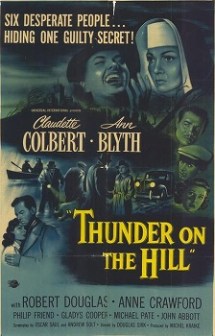
Thunder on the Hill (1951). This is a much more mature Ann Blyth than in Mildred Pierce. Interestingly, Blyth’s voice became much deeper and richer just in the few years between her mid-teens and early twenties. In this Douglas Sirk film noir, Blyth plays Valerie, a woman convicted of her brother’s murder. She is being transported via a mountainous road to her execution, however, it is delayed when she and the prison staff end up detained at a local convent hospital due to a torrential downpour flooding the road. Blyth’s Valerie is extremely bitter and angry about her entire life and she rejects everyone around her and demands to be left alone. Valerie insists that she’s innocent, but her pleas go unanswered because who wants to listen to a convicted murderess? It doesn’t help that dozens of people are also stranded at the convent and recognize Valerie. Murmurs go around the convent about the murderess on the premises and the audacity of the convent to allow it. Luckily for Valerie, Sister Mary (Claudette Colbert) has been following her case and is convinced of Valerie’s innocence and is determined to clear her name before the road opens up. This is a great movie and Blyth gives a fantastic performance as an angry woman wrongly accused of murder. It’s a very realistic performance. Who wouldn’t be upset to be on death row for a crime they didn’t commit?

Our Very Own (1950). This isn’t the most even film or the greatest film, however, Ann Blyth is great in it. This is another film where she seems much older and more mature than she was in Mildred Pierce, despite being filmed only 5 or so years later. In this film, Blyth plays Gail, a graduating high school senior, who on the evening of her 18th birthday, discovers that she was adopted. Her parents explain that they were going to tell her, but decided against it later. Gail insists on learning the identity of her birth mother (Ann Dvorak) and meets her. While the film is somewhat uneven and can’t decide what tone it wants to have, Blyth is very good. In fact the two Anns (Blyth and Dvorak) are the best part of this film and are worth watching. When Gail’s meeting with her birth mother does not go as hoped, Blyth is very adept at expressing her disappointment and anger without saying as much. Prior to the meeting, she skillfully displayed nervousness and apprehension–almost like she had a premonition that the visit wasn’t going to go well. Blyth’s character runs the gamut of emotions in this film, everything from happiness and giddiness in the scenes with her boyfriend (Farley Granger), anger and frustration in the scenes with her conniving sister, anger towards her parents for lying to her, hurt after her father inexplicably slaps her, and finally guilt for realizing that her best friend’s birth father is neglectful and selfish, whereas her adopted parents are loving and attentive.
If I can get a hold of them (::hint:: ::hint:: TCM play Ann Blyth’s films, Summer Under the Stars on her Aug 16 birthday), I can to catch up on all of her films I’ve missed.

RIP ANN BLYTH. THANK YOU FOR EVERYTHING–ESPECIALLY FOR BRINGING MY QUEEN, VEDA PIERCE, TO LIFE.