Categories
Favorite Classic Movies (Pre-1980)

My Favorite Film Discoveries of 2023

Happy Valentines Day, everyone! We’re about a month and a half into 2024 now, but I didn’t want to get too far into the New Year without having talked about my favorite new discoveries of last year. Per my Letterboxd stats page, last year I watched 397 films. I really wish I’d managed to squeeze in 3 more so I’d have an even 400, but alas. Now that’s not to say that all 397 titles were unique. I tend to rewatch movies, especially my favorites. Last year’s most watched stars were Joan Blondell, Barbara Stanwyck, Loretta Young, Humphrey Bogart and Cary Grant. My most watched directors were Howard Hawks, Alfred Hitchcock, Michael Curtiz, Mitchell Leisen, and William Wyler.

All in all, it was a good year for movie viewing–especially since I got to attend my first ever TCM Film Festival and had the best movie viewing experience of my life–Casablanca in Grauman’s Chinese Theater. I’d seen that movie four other times in the theater, and nothing will ever top seeing it at Grauman’s. For the record, my second best movie experience of the year was seeing Barbarella in 35mm at the Hollywood Theatre in Portland, OR. Seeing a campy movie like Barbarella with an audience that was completely entranced and loving every second, was fantastic. There was even a girl dressed like Barbarella, in a short silver dress, knee-high boots, and big hair–despite it being January in Oregon! Now that’s dedication!

Anyway, without further adieu, these are all my new watches of 2023:

  • The Apple (1980)
  • Appointment with Danger (1950)
  • Arsene Lupin (1932)
  • Ask Father (1919)
  • Barbie (2023)
  • Because of You (1952)
  • Between Midnight and Dawn (1950)
  • Big Business Girl (1931)
  • Big City Blues (1932)
  • Billy Blazes Esq. (1919)
  • Black Angel (1946)
  • Born to Be Bad (1934)
  • Born to Kill (1947)
  • The Boy and the Heron (2023)
  • Brute Force (1949)
  • Captain Carey, USA (1949)
  • Carnal Knowledge (1971)
  • The Children’s Hour (1961)
  • China (1943)
  • Cops (1922)
  • Deadline at Dawn (1946)
  • Dead Men Don’t Wear Plaid (1982)
  • Deception (1946)
  • Deep Valley (1947)
  • Desert Fury (1947)
  • The Desperate Hours (1955)
  • The Doctor and the Girl (1949)
  • Dragonwyck (1946)
  • Earth Girls Are Easy (1988)
  • An Eastern Westerner (1920)
  • Enter the Dragon (1973)
  • Experiment Perilous (1944)
  • Fallen Angel (1945)
  • The Famous Ferguson Case (1932)
  • Father Goose (1964)
  • Female on the Beach (1955)
  • The Five Pennies (1959)
  • Flaming Star (1960)
  • Flaxy Martin (1949)
  • Footlight Parade (1933)
  • Framed (1947)
  • A Free Soul (1931)
  • The Gilded Lily (1935)
  • Gold Diggers of 1937 (1936)
  • Grand Slam (1933)
  • The Great Moment (1944)
  • Guardians of the Galaxy, Vol 3 (2023)
  • Harvey (1950)
  • High and Dizzy (1920)
  • High Pressure (1932)
  • Honky Tonk (1941)
  • Houseboat (1959)
  • The Iron Mistress (1952)
  • I’ve Got Your Number (1934)
  • King Kong (1933)
  • Kiss the Blood Off My Hands (1948)
  • Ladies in Retirement (1941)
  • The Lady in Question (1940)
  • The Lady is Willing (1942)
  • Larceny, Inc. (1942)
  • Life Begins (1932)
  • The Life of Jimmy Dolan (1933)
  • Love Has Many Faces (1965)
  • Love Me Tender (1956)
  • Make Me a Star (1932)
  • The Man I Love (1946)
  • The Mask of Dimitrios (1946)
  • Mr. Cohen Takes a Walk (1935)
  • Mr. Soft Touch (1949)
  • Mrs. Parkington (1944)
  • Naughty But Nice (1939)
  • The Navigator (1924)
  • Night Editor (1946)
  • One Week (1920)
  • Passion Flower (1930)
  • The Petrified Forest (1936)
  • Play Girl (1932)
  • The Princess Comes Across (1936)
  • The Purchase Price (1932)
  • Race Street (1948)
  • Red Light (1949)
  • Rio Bravo (1959)
  • Romancing the Stone (1984)
  • Search for Beauty (1934)
  • Second Honeymoon (1937)
  • Secret Beyond the Door (1947)
  • The Secret Life of Walter Mitty (1947)
  • Shakedown (1950)
  • Shane (1953)
  • The Silver Horde (1930)
  • Singapore (1947)
  • The Sky’s the Limit (1943)
  • Stand-In (1937)
  • Strange Bargain (1949)
  • That Touch of Mink (1962)
  • There’s Always a Woman (1938)
  • Tight Spot (1955)
  • Traveling Saleslady (1935)
  • The Unfaithful (1946)
  • The Unguarded Hour (1936)
  • Union Depot (1932)
  • Week-End Marriage (1932)
  • Weird: The Al Yankovic Story (2022)
  • Whiplash (1948)
  • Wild in the Country (1961)
  • Woman in Hiding (1950)
  • A Woman’s Face (1941)
  • A Woman’s Vengeance (1948)

That was a lot of new movies last year, 108 in fact. I discovered a lot of new favorites and discovered some films that I never want to see again (The Apple, I’m looking at you). I’m not going to include the new films I saw, but I want to go on the record to say that Barbie, The Boy and the Heron, and Weird: The Al Yankovic Story were awesome.

Here are my Top 5 favorite new discoveries:

This is an incredibly misleading poster.

#1 Ladies in Retirement (1941). In September, Criterion Channel featured a series called “Gaslight Noir” which I took to mean film noir that took place during the Victorian era, but I think Criterion stated that it was “dark and moody film noir.” This film stars Ida Lupino, and was a movie that I’d heard about, but had never seen. I wasn’t even aware it was a film noir, the title makes it seem like it is a light-hearted film about rich women who live a life of leisure. However, that is definitely not what this movie is about. Ida plays spinster, Ellen Creed, who works as a housekeeper and live-in companion to her wealthy friend, Leonora Fiske. Ellen has two eccentric sisters who are about to be evicted from their apartment due to their behavior. Not wanting her sisters to be homeless, Ellen takes them in and convinces Leonora to let them stay. The sisters quickly wear out their welcome and Leonora demands that Ellen force them to leave. Not wanting her sisters to end up in an institution, Ellen takes matters into her own hands.

I did not expect the turn that this movie took and I absolutely loved it. I loved the setting of this remote English home that seems perpetually encased in fog. This movie had a spooky vibe to it and I just loved it. I wish that someone would put it out on blu ray.

#2 A Woman’s Face (1941). This is a Joan Crawford film noir that TCM played earlier this year. I’d heard of this film, but had never seen it scheduled. In this film, Joan plays blackmailer Anna Holm, a woman who bears a large, disfiguring scar on her face. Because of this disfigurement, Anna carries a lot of resentment and hostility towards others, which is why she has no empathy or remorse for carrying out her blackmail scams. Eventually, she gets plastic surgery from Dr. Gustaf Segert (Melvyn Douglas) to cover the scar. Without the scar to hide behind, Anna is forced to confront her insecurities, her anger over her past, and her current life of schemes and crimes.

Most of the plot unfolds through a series of flashbacks, told through witness testimony in a court trial, where Anna is being tried for murder. Joan Crawford’s performance is fantastic as her character evolves throughout the film. Melvyn Douglas is great as the doctor who provides emotional support and sees Anna for whom she really is. Conrad Veidt as an excellent villainous role as the wealthy Torsten Barring, her partner in crime as well as her lover. The ending of the film is exciting and memorable.

#3 Harvey (1950). This was a discovery for my husband and I at the TCM Film Festival. I’d heard of this film, but I just hadn’t gotten around to seeing it yet. We absolutely loved it. In this film, James Stewart plays Elwood P. Dowd, a man who by all accounts is eccentric. His best friend is an imaginary friend, a 6’3.5″ rabbit named Harvey. His sister, Veta (Josephine Hull), is absolutely embarrassed and horrified by her bother’s behavior. Elwood doesn’t see anything wrong with his behavior and insists that Harvey is real. Veta eventually is so fed up that she goes down to the sanitarium to have Elwood committed and she ends up being committed herself. Harvey is expertly crafted to make the audience wonder if Elwood really is delusional and Harvey isn’t real, or is Harvey real and only Elwood can see him?

Josephine Hull won the Best Supporting Actress Oscar in the 1950 Oscars race and while I don’t know that she deserved to win over Nancy Olsen for Sunset Boulevard or Thelma Ritter for All About Eve, Hull is hysterical as Veta. She very much seems like her character from Arsenic and Old Lace, except without the murder aspect. James Stewart is the true standout performance (aside from Harvey, of course) in this film. He expertly plays Elwood P. Dowd to be friendly and likeable, there isn’t really any reason to distrust or dislike him. He seems content with his life and best friend. Peggy Dow is also a lot of fun as the nurse at the sanitarium, she’s also gorgeous as well.

#4 Shakedown (1950). Speaking of Peggy Dow, she’s in this film as well. In this movie, Howard Duff plays a cock-of-the-walk photographer, Jack Early, who will do anything to get a great photo. He manages to use these tactics to score a job at a prominent San Francisco newspaper, headed up by Ellen Bennett (Dow), the photography editor and David Glover (Bruce Bennett), the editor-in-chief. David is unimpressed by Jack’s somewhat questionable methods for getting the photos, but hires him anyway. He gives Jack the impossible assignment of getting a photograph of the face of local gangster, Nick Palmer (Brian Donlevy), a man who notoriously does not want his picture taken. Jack easily scores the photo by appealing to Nick’s ego. Appreciating Jack’s nerve, Nick takes him under his wing and tells him that the head of the rival gang, Colton (Lawrence Tierney), is planning a job. He gives Jack the time and location. He easily gets the photo and brings it back to David. Colton gets wind of Jack and hires him to pull one over on Nick. Jack continues playing both gang members against each other, all while David and Ellen start becoming more and more skeptical as to how Jack keeps scoring these amazing photos. Eventually Jack gets in over his head.

This was such a great movie. I didn’t know what to expect from it and was so impressed by all the twists and turns that the plot took. I highly recommend this film to anyone who loves a good film noir.

#5 Shane (1953). I’m not a big westerns fan, but I watched this one because I’ve recently been on an Alan Ladd kick and I’d never seen what is probably his biggest, most well known role. Ladd plays the titular Shane, a drifter who arrives at a small town in Wyoming. Most of the town is comprised of homesteaders who moved west, taking advantage of the government’s offer to give free land to people wishing to move west of the Mississippi and set-up their own homes, farms, ranches, etc. Upon arriving in town, Shane encounters Mary and Joe Starrett (Jean Arthur and Van Heflin), a couple living off of the land they received from the government. Mary and Joe also have a young son, Joey (Brandon DeWilde) who immediately admires Shane. The main conflict of the film is a ruthless cattle baron wants to use force to push the Homesteaders off their viable land, so that he can take it over and grow his cattle empire.

This is such a beautiful film. Alan Ladd was great as the mysterious stranger who comes into town, helps out some of the folks, and leaves just as mysteriously as he came. His scenes with Joey are adorable and he’s great with Jean Arthur as well. Jack Palance was great as one of the cattle baron’s men, Jack Wilson, and he has a fun showdown with Ladd at the end of the film.

Honorable Mentions: Dragonwyck (1946), Enter the Dragon (1973), Larceny, Inc. (1942), Experiment Perilous (1944), and Deep Valley (1947).

Categories
Blogathon Favorite Classic Movies (Pre-1980) Favorite Perfomers

The Party Like It’s 1899 Blogathon–James Cagney and Humphrey Bogart

Happy New Year, everyone! Another busy holiday season has passed. So that I didn’t miss yet a second blogathon (I’ll get back to the Warner Bros one, even though I am way past the date to turn in my post), I wanted to get my post about two of my faves–James Cagney and Humphrey Bogart, finished. 

Cagney and Bogart have a lot in common:

  • Both born in 1899 (Cagney on July 17th and Bogart on December 25th).
  • Both were born in New York City.
  • Both started their careers on the New York stage.
  • Both were Warner Brothers contract players.
  • Both were known for their gangster films.
  • Both won their respective Oscars playing non-gangster characters (Cagney for Yankee Doodle Dandy and Bogart for The African Queen).
  • Both are iconic stars of Classic Hollywood.
James Cagney in 1930.

However, Cagney and Bogart’s childhoods couldn’t be more different. Cagney was born into a lower-class neighborhood and grew up in a tenement. His father was a bartender and his mother was the daughter of a barge captain. Eventually Cagney was forced to drop out of school and support the family financially when his father succumbed to influenza during the 1918 epidemic in the United States. Cagney held a variety of odd jobs before finding work in the theater. He worked as a junior architect, a copy boy, book custodian, bellhop, draughtsman (doing technical drawings–I looked it up), and a night doorkeeper. As a child, Cagney also took tap dancing (which would serve him well in Yankee Doodle Dandy) and also was a skilled street fighter (which I’m sure served him well in his films). In 1919, Cagney’s dancing ability earned him a spot in the New York stage production of Every Sailor. He would continue performing on the stage until 1930 when the stage production of Sinners’ Holiday brought he (and co-star Joan Blondell) to Hollywood for the film adaptation.

Humphrey Bogart in The Petrified Forest (1936)

Bogart’s upbringing couldn’t be more different than Cagney’s. Born into an affluent family who owned an apartment on the classy Upper West Side of New York, Bogart was not suffering. In addition to their apartment, the Bogart parents also owned a lake home on 55 acres. Rare for the time, Bogart’s mother was an extremely successful commercial artist who did illustrations for companies such as Anheuser-Busch, Ivory Soap, and Metropolitan Life Insurance. Despite the legend that baby Humphrey served as the Gerber Baby model, this is not true. The famous Gerber baby logo was not designed until Bogart was an adult and his mother did not design it. Mrs. Bogart did use an illustration of baby Humphrey for Mellins Baby Food. For the record, the original 1926 Gerber Baby was Ann Turner Cook. She was born in 1926 and just passed recently–2022. The sketch was drawn by Cook’s neighbor, Dorothy Hope Smith, who submitted the drawing in response to Gerber’s contest looking for their new logo. Smith’s successful illustration earned her $300 (or $5386 in 2023).

I love this part of Casablanca, I never tire of it.

But enough about the Gerber Baby, back to Bogart. Despite his privileged childhood (with Bogart’s parents earning a combined $70,000 annually, a huge sum for the 1900s-1910s), Bogart was not an academic scholar. He attended numerous fancy pants private schools, eventually ending up in an esteemed boarding school–of which he was kicked out. Mr. and Mrs. Bogart had hoped their son would attend Yale, but that was pretty much off the table once he was kicked out of school. In 1918, Bogart joined the Navy and enjoyed his time after the Armistice ferrying soldiers back from Europe. In 1921, Bogart made his stage debut in Drifting. In 1928, Bogart appeared in a short film, The Dancing Town, and in a 1930 short, Broadway’s Like That. Also in 1930, the same year Cagney was making his screen debut, Bogart secured a contract with Fox and appeared in his first film Up the River, with soon-to-be lifelong friend, Spencer Tracy.

However, unlike Cagney, Bogart’s Hollywood stardom wasn’t instant. Despite having appeared in a series of films for Fox, there was no single breakthrough role for Bogart. Cagney shot to super stardom in his sixth film, The Public Enemy (1931). He was unstoppable after that and appeared in a series of successful gangster films. Cagney also regularly waged wars with Jack Warner, head of Warner Brothers, demanding more money after each successive hit film. Unfortunately, Bogart was not in the same position to make such demands, having not appeared in a hit film. After a couple false starts in Hollywood, Bogart finally got the role he was hoping for when he appeared in 1936’s The Petrified Forest. ‘Forest’ was a Broadway play that featured Bogart and Leslie Howard. Warner Brothers bought the rights to the story and brought Howard out to Hollywood to reprise his role. However, they wanted their star, Edward G. Robinson to appear in Bogart’s role, Duke Mantee. Howard responded to Warners’ request by sending a telegram stating “No Bogart, No Deal.” Warners acquiesced to Howard’s demands, and Bogart’s star was finally on the ascent. He would finally become a bona fide superstar, achieving Cagney’s level of stardom, with a series of hits, one after another–High Sierra (1940), The Maltese Falcon (1941), and Casablanca (1942).

Cagney and Bogart appeared in three films together: Angels with Dirty Faces (1938), The Roaring Twenties (1939), and The Oklahoma Kid (1939)

These are my Top 5 Favorite Cagney and Bogart Films:

(Please excuse me if some of your favorites aren’t listed, either I haven’t seen it, I haven’t seen it for a long time and can’t remember it, there wasn’t enough room in my Top 5, or maybe I loved something else more!)

JAMES CAGNEY

  1. White Heat (1949) This is probably my favorite Cagney film. His portrayal of the vile Cody Jarrett is captivating. He is a terrible person, but in some ways, you can’t help root for him. He’s the villain of the story, but he’s complicated and has some good points, especially where his mother is concerned. There’s also no denying that the ending of White Heat is one of the all-time most iconic scenes in cinema history.

  2. The Public Enemy (1931). There’s no denying that Cagney’s break-through role isn’t one of his best. This film features the iconic scene of Cagney smashing Mae Clarke’s face with a grapefruit. It also features future stars Jean Harlow and Joan Blondell. What more could you want? Cagney screams star quality even in the opening credit sequence where he makes a little punching motion and raises his eyebrows.

  3. Footlight Parade (1933). This film features Cagney tap dancing and hoofing his way through multiple numbers as he plays a producer trying to save his career by producing a series of prologues. He is once again paired with Joan Blondell who plays his secretary who is in love with him and horribly jealous of Cagney’s interest in Claire Dodd. The trio of prologues at the end of the film is the highlight. Also a highlight? Cagney trying to teach Frank McHugh how to move like a cat.

  4. Picture Snatcher (1933). In this film, Cagney plays a “picture snatcher,” the 1930s equivalent of paparazzi. Cagney is an employee of editor, Ralph Bellamy, who is reluctant to hire him. However, Cagney soon wins his place on the team by using rather unscrupulous methods to obtain hard-to-get in demand photos for his newspaper. Eventually, Cagney’s ethics are put to the test when he is admitted to an execution at Sing Sing, where one of the rules is “no pictures.”

  5. Taxi! (1932). Cagney is paired up with Loretta Young in this film where he plays a scrappy taxi cab driver in New York City. Loretta’s father, cab driver Guy Kibbee, is facing pressure from a rival cab service who wants his primo location. The rival cab service is using force to try and dominate the entire cab industry in New York City. Loretta appeals to Cagney to encourage his colleagues to fight back against the rival cab company (aka the mob).

HUMPHREY BOGART

  1. Casablanca (1942). It’s cliche, but this is probably my favorite Bogart film and my second favorite film overall (after The Long Long Trailer). Every piece of this film is iconic, from the score, to the dialogue, to the actors’ performances. Even though I’ve seen it a million times, Bogart’s iconic “hill of beans” speech to Ingrid Bergman at the end of the film still gives me goosebumps. I never tire of it.

  2. The Maltese Falcon (1941). Another cliche choice, but film noir was born with this film and Bogart’s Sam Spade was pretty much the archetype for the film noir detective. The entire cast is fantastic and initiated another great partnership–between Sydney Greenstreet and Peter Lorre. This film is also notable for being John Huston’s directorial film debut.

  3. Treasure of the Sierra Madre (1947). Not a deep-cut but it’s hard to find one in Bogart’s career when he made so many hit films. Bogart’s run of films in the 1940s might be the most successful run of films anyone has ever had. An actor would probably be happy just having a Casablanca as part of their resume. However, Bogart has not only Casablanca, he has ‘Falcon,’ High Sierra, To Have and Have Not, Key Largo, The Big Sleep, Dark Passage, and Treasure of the Sierra Madre. After Rick Blaine, Bogart’s most famous character might be Fred C. Dobbs. Bogart turns in an excellent performance where he starts out as a desperate man just looking to survive in Mexico. He is given a chance to make a bunch of money mining for gold, eventually succumbing to the greed and desperation that motivates his need to get as much money as possible–at whatever cost is necessary.

  4. To Have or Have Not (1944). This is the film that introduced Bogart and Lauren Bacall to not only audiences, but to each other! Bacall was a discovery of director Howard Hawks’ wife, who spotted her on the cover of Harper’s Bazaar. Despite their 25 year age difference, Bogart and Bacall’s chemistry is off the charts and they steal the show. Bacall has one of the all-time greatest screen debuts, where not only is she an instant star, she also became half of an indelible part of Classic Hollywood history–the legendary Bogie and Bacall romance. Bacall also delivers the iconic “you do know how to whistle don’t you? You just put your lips together and blow” line.

  5. In a Lonely Place (1950). This is an absolutely spectacular film noir directed by Nicholas Ray and co-starring Gloria Grahame. Bogart’s son, Stephen, stated that In a Lonely Place is the closest depiction to the real Bogart that was ever captured on film. Bogart’s character is a complicated man. He is capable of love, empathy, loyalty, romance, etc. as depicted in his relationship with Grahame. However, he is also shown as being capable of violence, through depictions of his explosive temper causing him to engage in a serious road rage incident with a fellow motorist. The conflict of the entire film is that a woman who was last seen with Bogart is murdered, but he is cleared as a suspect with Grahame providing an alibi. However, as more and more of his personality and temper is revealed, the film begins to question Bogart’s innocence. This is a fascinating film.
Bogart and Cagney in The Roaring Twenties.
Categories
Favorite Classic Movies (Pre-1980)

#Noirvember 2023

Another Noirvember is upon us. I’ve been pretty spotty in trying to take part in these online events, so once again I’m going to try my best to participate. #Noirvember is an ode to all that is film noir that was started a few years ago by @oldfilmsflicker on Twitter. It’s become a highly anticipated event that has taken on a life of its own and is now promoted by everyone from film fans to movie theaters.

Anyway, because I can’t just simply watch film noir in November, I have to make myself some sort of challenge. One reason is that it makes it more interesting and forces me to check out films, actors, directors, etc. that I may not have otherwise, or it would have taken me longer. While deciding what to do for my challenge, I wanted to make sure that I allowed myself to watch old favorites like Double Indemnity (1944). However, I want to make sure that I also watch some new titles–if only to get through some of the blind buys that I’ve purchased throughout the year. I don’t want to force myself to only watch “new” films, because then I’ll be sad that I can’t watch my favorite Alan Ladd film noir (e.g.). While I did this challenge in the past and ALMOST finished it, I am going to give it another go this month–I am going to follow-up my next film noir with a film that has an actor in common with the film that preceded it.

I’m also not going to limit myself to just one film per day. Some days I can fit in only one film, other days I can fit in 2-3. Due to my regular Monday night board game group, I may not be able to get a film noir watched every single day; but I’ll do my best. I’m also hoping that I can finagle it where the last film I watch connects to the first film. We’ll see what happens as my movie watching will be organic. I do not have it planned out in advance! Just to keep myself on my toes.

Without further much ado. These are the films watched for #Noirvember. Click on the link to view more information about the film and to see what connected it to the previous film!

EDIT: Woo! Did it. The final film, The File on Thelma Jordon, connects to the first film, Double Indemnity, using the Queen of Film Noir, Barbara Stanwyck.

November 1st- Double Indemnity (1944)

November 1st- Singapore (1947)

November 2nd- The Killers (1946)

November 3rd- White Heat (1949)

November 4th- Red Light (1949)

November 5th- Race Street (1948)

November 5th- The Glass Key (1942)

November 6th- Shakedown(1950)

November 7th- Brute Force (1947)

November 8th- Mildred Pierce (1945)

November 9th- The Unfaithful (1947)

November 10th- The Mask of Dimitrios (1944)

November 12th- Gilda (1946)

November 14th- Human Desire (1954)

November 14th- In a Lonely Place (1950)

November 15th- Dark Passage (1947)

November 16th- Key Largo (1948)

November 17th- Murder, My Sweet (1944)

November 19th- Pitfall (1948)

November 25th- Too Late for Tears (1949)

November 26th- Desert Fury (1947)

November 29th- Sorry, Wrong Number (1948)

November 30th- The File on Thelma Jordon (1949)

Categories
Blogathon Favorite Classic Movies (Pre-1980)

The Linda Darnell Centennial Blogathon–“Hangover Square” (1945)

[Spoilers re: Hangover Square ahead]

As the title of the blogathon suggests, October 16th, 2023 would have been Linda Darnell’s 100th birthday. Linda isn’t an actress that is well known today, except in circles of more devoted fans of Classic Hollywood. While she appeared in many big projects at the time (The Mask of Zorro, My Darling Clementine, A Letter to Three Wives, to name a few), she never had a Casablanca or The Wizard of Oz or Gone With the Wind-type film that would make her a household name. In film noir circles, what Linda is known for is being a sultry, smoldering femme fatale in 1940s noir such as Fallen Angel and Hangover Square, both released in 1945. The latter film is what I will be discussing in this article.

Today, Hangover Square doesn’t typically rank on many “top film noir of all time” lists; it doesn’t seem to be well known. Despite having seen dozens of film noir, I’d never heard of it until I saw it included in one of Kino Lorber’s quarterly sales. I purchased it as a blind buy and absolutely loved it. It was so different than other noir that I’d seen prior. Linda Darnell is the femme fatale of the story and despite leaving the film about 2/3 the way through, her presence and effect on the protagonist are felt through to the film’s fiery conclusion.

In Hangover Square, Laird Cregar plays George Harvey Bone, a composer working in a home on Hangover Square in Edwardian London in 1903. George has been working so intensely and hard on his concerto that he is overworked and stressed. Because of the stress, George is prone to blacking out and bouts of amnesia. George’s blackouts are triggered whenever he hears discordant sounds, such as the crash of metal piping falling off a wagon. At the beginning of the film, George is in the middle of one of his amnesiac episodes, where he stabs a shop owner to death.

From the get go, the audience knows that George is a murderer. He confides in his literal girl next door girlfriend, Barbara (Faye Marlowe), that he cannot remember his actions the night prior. She refers George to the doctor at Scotland Yard, Dr. Allan Middleton (George Sanders). While talking to Dr. Middleton, George tells him about how unpleasant sounds triggers these blackouts where he cannot remember his whereabouts and actions for a period of time. From this point in the film, Dr. Middleton’s character somewhat disappears from the story; but he will be back. It’s time for Linda Darnell to enter the fray.

Linda plays singer Netta Longdon. Netta is not very talented. Her act consists of a bad song, which doesn’t matter because she flashes her legs a lot at the male audience. One night, George goes to see her sing at a “smoking concert” in a local saloon. I researched “smoking concerts” and learned that they were live performances put on for a male-only crowd. While listening to the live entertainment, the men would engage in “manly pursuits” like smoking and discussing politics. Obviously an environment too sensitive for women, but not too sensitive for women to entertain the men with raunchy (for Victorian era) dancing. Anyway, George is captivated by Netta and wants to meet her.

The sultry Linda Darnell charms Laird Cregar into writing an arrangement for her.

Upon meeting George, it’s obvious that Netta is uninterested in him. However, she perks up when she learns that he’s a composer and seems to have an ear for writing catchy music. With help of a mutual acquaintance, Mickey, Netta learns that there’s a song with lyrics that would be more suited for her “talents,” but she needs an arrangement, which she decides George should compose. Because he’s enamored with the beautiful, sultry Netta, George sets his major composition aside to work on her arrangements.

Netta continues to string George along, letting him wine and dine her and perform other favors. He’s basically become her sugar daddy, with nothing in return. Despite supposedly dating Barbara, George is smitten with Netta. Linda Darnell’s portrayal makes it easy to see why. She plays Netta to be sultry, with a bit of an aloofness–much like her “Stella” character in Fallen Angel. However, the aloofness all but disappears when she learns of George’s composer background. Netta is the perfect femme fatale here, as she all but disrupts George’s life, because he has mistaken her coy behavior and flirting for interest. This is never more telling than in the scene when she and George kiss, and Netta opens her eye that faces the camera. This is not a woman who is in love. This is a woman who knows that she’s just sealed the deal on getting this man to punch her ticket out of Hangover Square.

Laird Cregar and his cat.

Eventually, as one can suspect, George catches onto Netta’s deception when he spots her leaving her apartment. She had just feigned a headache and ended their evening prematurely, due to having received a more appealing offer. He is incensed about her betrayal and ends up strangling her to death during the annual Guy Fawkes Night. At the centerpiece of the evening’s festivities is an enormous bon fire. In a rather gruesome scene for 1945, George puts a Guy Fawkes mask on Netta’s face, to hide that she’s a real dead body, not a dummy, and places her corpse on the top of the bonfire.

Laird Cregar, George Sanders and the gas lamp in “Hangover Square.”

This serves as the final piece of inspiration that George needed to finish his composition. The composition is unveiled at a performance to be attended by the elite. By this point, Scotland Yard is onto George. The walls are closing in. As George starts his performance, the events of the previous 60 minutes flash by, accompanied by George’s concerto. Barbara’s scenes are more relaxing, except for the scene when George almost strangles her during one of his blackouts. The music swells and gets more intense. However, when he gets to the Netta section of the composition, the notes become more dramatic, more angry. There is a lot of hurt in this section. The pain is evident on George’s face and he really goes off the rails during this section. He goes so far off the rails in fact, that he has to stop and has Barbara take over and finish the performance.

The film ends in really the only way it can. George starts a fire with a gas lamp. The entire building goes up in flames. The audience and orchestra rush out before the room is consumed in flames. All of this happens as George stands in the middle of the room begging people to stay so that they can hear the end of his concerto. His masterpiece. The people rightfully look at him like he’s nuts. George resumes his place on the piano bench and plays his heart out, finishing the concerto while he is consumed by fire and smoke.

While Hangover Square is Laird Cregar’s film, there is no denying that Linda Darnell plays a pivotal role. Her character’s betrayal is what finally causes George to lose his remaining grasp on reality. He is a shell of the shell of a man he was before. However, it is easy to see that George’s murder of Netta gave him the inspiration for the final portion of his concerto. Their relationship and her murder is the most dramatic portion of the concerto. This woman affected him deeply during life and even more so after death.

Linda Darnell shows off her gams during the “smoking concert.”
Categories
Blogathon Favorite Classic Movies (Pre-1980)

The Celluloid Road Trip Blogathon: Int’l Edition–“Gilda” (1946)

GILDA: “You do hate me, don’t you, Johnny?”
JOHNNY: “I don’t think you have any idea of how much.”
GILDA: “Hate is a very exciting emotion. Haven’t you noticed? Very exciting. I hate you too, Johnny. I hate you so much I think I’m going to die from it. Darling…”
[GILDA and JOHNNY kiss passionately]
GILDA: “I think I’m going to die from it.”

Rita Hayworth as “Gilda” and Glenn Ford as “Johnny” in Gilda (1946)

It is said that there is a fine line between love and hate. The above quote between the two central characters in 1946’s Gilda perfectly illustrates this phrase. At the beginning of the film, our anti-hero Johnny Farrell (Glenn Ford) is shooting craps in an alley in Buenos Aires, Argentina. He wins handedly using a pair of loaded dice. When his opponents realize they’re being cheated, Johnny’s life (and winnings) is at stake. He is saved by a mysterious stranger, Ballin Mundson (George Macready). Ballin tells Johnny about a nearby illegal high class casino, but warns him against cheating. Johnny doesn’t heed Ballin’s warnings however, and is caught cheating at Blackjack. He’s brought in front of the owner who turns out to be Ballin. Johnny turns on the charm and smooth talk and convinces Ballin to hire him. He soon becomes Ballin’s casino manager.

“There NEVER was a woman like Gilda.”

Time passes and Ballin leaves for a trip. When he returns, he announces to Johnny that he’s married and wants to introduce his new wife, Gilda. Cue one of the most famous film entrances of all time–Rita Hayworth’s “Gilda.” With a flip of the hair and a seductive, “Me?… Sure I’m decent,” Gilda enters the fray. Johnny’s face transforms into a scowl as he spots the new Mrs. Mundson. Gilda also appears simultaneously angry and surprised. It is obvious from Johnny and Gilda’s reactions that these two have a past–an unhappy past, at that. The circumstances of their previous relationship are never made clear; but it would seem that Johnny hurt Gilda deeply. She still loves him, but he harbors some type of resentment towards her. Ballin seems clueless to Johnny and Gilda’s body language and assigns Johnny to watch over her. This ignites a vicious game between Gilda and Johnny where she, out of anger towards Johnny, cavorts with other men at all hours to make him jealous. Johnny, out of loyalty to Ballin, does all he can to break up Gilda’s dates and cover up her supposed affairs.

JOHNNY: “Pardon me, your husband is showing.”

Glenn Ford as “Johnny” in Gilda (1946).

The type of relationship Ballin and Johnny have with one another is up for debate. On the surface, it would appear that Johnny is fiercely loyal to his employer. However, other classic film fans and experts have found homoerotic subtext in the Ballin/Johnny relationship. I am not well-versed in this subject and honestly never considered this angle; however, having seen the film multiple times, I understand this interpretation. Not being an expert, I am not going to analyze the film from this viewpoint. In the spirit of this blogathon’s theme of an “international road trip,” I want to discuss Johnny and Gilda’s relationship and how it unfolds against the Buenos Aires, Argentina and Montevideo, Uruguay setting.

One of the most famous film entrances of all time.

Gilda was originally supposed to be a gangster film set in the United States. It was decided to switch the setting to Argentina. During the 1930s and 1940s, Franklin Delano Roosevelt promoted the “Good Neighbor Policy,” as a means to improve the United States’ relationship with Latin America. Hollywood was encouraged to set films in Latin America and depict the countries and people in a positive light. The Latin America in Gilda is depicted as a tropical, fun, sexy, romantic, wealthy, cosmopolitan city inhabited by people from all walks of life. Buenos Aires, Argentina’s capital, is often promoted as “the world’s most beautiful city.” This seems the perfect setting for the gorgeous Rita Hayworth, whose luminous face shines in this film and makes it completely believable that all the men in this film are so preoccupied with her.

JOHNNY: “I hated her so I couldn’t get her out of my mind for a minute. She was in the air I breathed–and the food I ate.”

Glenn Ford as “Johnny” in Gilda (1946)
Gilda and Johnny at Carnival.

One of the highlights of Gilda is the annual Carnival celebration, which takes place during the summer in the Southern Hemisphere in February. Carnival is an annual celebration that takes place in Roman Catholic countries in the three days leading up to Lent. This celebration allows communities to dress in costumes, play music, eat delicious food and drink, and basically lose their inhibitions and deal with the consequences later. In the film, Gilda is celebrating her first Carnival. She dons a gaucho costume, complete with an eye mask. Johnny is much less festive, as he simply puts on an eye mask with his tuxedo. During Carnival, Gilda allows herself to let go of her contempt for Johnny and embrace her love of him. She becomes nostalgic for their former relationship and reminisces about dancing with him. Gilda dances closely with Johnny, completely losing herself in the moment. He remains standoffish towards her and refuses to get caught up in the spirit of Carnival. Johnny won’t throw caution to the wind and rekindle things with Gilda. He pushes her away when her passion starts getting too intense.

GILDA: “You’re out of practice aren’t you–dancing I mean. I can help you get in practice again, Johnny–dancing I mean.”

Rita Hayworth as “Gilda” in Gilda (1946)
Gilda with Ballin and Johnny

Ballin’s presence and influence looms in the background, both literally and figuratively. The Carnival celebration is both the turning point in the film and in Gilda and Johnny’s relationship. It reignites their formerly red-hot relationship, as well as confirms third-wheel Ballin’s suspicions that there is more to his wife and employee’s relationship than it seems. Ballin’s hunch is confirmed after he walks in on Gilda and Johnny kissing. Too bad he missed their first kiss. His anger over seeing his wife and employee smooching serves as the impetus for Ballin’s actions in the second and third acts of the film.

JOHNNY: “I thought we agreed that women and gambling didn’t mix.”
BALLIN: “My wife does not come under the category of women, Johnny.”

Glenn Ford as “Johnny” and George Macready as “Ballin” in Gilda (1946)

Gilda and Johnny’s intense love-hate relationship continues to heat up as the action shifts to Montevideo, Uruguay. By this point, Ballin is presumed dead after crashing his plane into the ocean. Johnny and Gilda marry. However, Johnny decides to use his marriage to Gilda as a means to punish her for supposedly betraying Ballin. Johnny conveniently seems to forget that he actually betrayed Ballin by hooking up with Gilda. He treats Gilda so cruelly, she escapes to Montevideo. To showcase Rita Hayworth’s dancing ability, Gilda gets a job as a singer and dancer at a nightclub. She performs a sexy song and dance number, wearing a gorgeous two-piece dress while crooning “Amado Mio.”

Gilda in her “Amado Mio” costume.

Later, to escape Johnny, Gilda returns to Buenos Aires and resumes her singing and dancing career. Fed up with Johnny’s treatment of her, Gilda decides to be the tramp he thinks she is. In the famous “Put the Blame on Mame” number, Gilda performs a one-glove striptease. Before she can unzip her strapless black dress, Johnny sends in his goon to stop Gilda and bring her to Johnny. Their love-hate relationship reaches its peak when Johnny slaps Gilda to punish her for her behavior. Gilda is distraught that the man she loves so intensely would hurt her.

GILDA: “Would it interest you to know how much I hate you, Johnny?”
JOHNNY: “Very much.”
GILDA: “I hate you so much that I would destroy myself to take you down with me.”

Rita Hayworth as “Gilda” and Glenn Ford as “Johnny” in Gilda (1946)
Gilda in her famous black dress

Gilda also features a plotline about Ballin being involved in a tungsten cartel with some Germans, but frankly, NOBODY cares about this plot point. Does anyone even remember the tungsten thing? No. Because this movie is all about Gilda and Johnny’s intense love-hate relationship. Are Gilda and Johnny truly in love with each other? I think they love each other, but for some reason, Johnny has some sort of issue with Gilda. Johnny’s dismissive attitude towards her causes Gilda intense hurt, leading her to torment him any way she can.

Despite being included on many “Best Film Noir Femme Fatale” lists, I don’t think Gilda is a femme fatale. In many ways, she’s the victim of this film–tormented by the two men in her life, Johnny and Ballin. Gilda’s intense love and subsequent hurt (caused by Johnny) drives her motivation to make Johnny jealous and unhappy. She wants him to feel what she feels. Johnny seemingly hates her for her actions, but his love for her motivates his jealousy. It’s a vicious cycle, one that Johnny and Gilda seemingly overcome at the somewhat contrived ending.

JOHNNY: “I want to go with you, Gilda. Please take me. I know I did everything wrong.
GILDA: “Isn’t it wonderful? Nobody has to apologize, because we were both stinkers, weren’t we? Isn’t it wonderful?”
JOHNNY: “Wonderful.”

Glenn Ford as “Johnny” and Rita Hayworth as “Gilda” in Gilda (1946)

Do we really think Johnny and Gilda will continue to be happy after the film ends?

Categories
Blogathon Favorite Classic Movies (Pre-1980)

Shades of Shane Blogathon- “The Glass Key” (1942)

It’s the 70th anniversary of Shane, a western widely considered one of the best of all time–it’s even one of the movies on my scratch-off poster, “100 Essential Films.” However, I’ve never seen it. It’s definitely on my list though. I recently discovered Alan Ladd over the past year or so and I love Jean Arthur. Shane is her last film. Anyway, when I saw this blogathon, and saw that the objective was to discuss anyone associated with Shane, a la Alan Ladd, I thought it would be a good opportunity to talk about my favorite Ladd collaboration with frequent co-star, Veronica Lake–The Glass Key.

Veronica Lake and Alan Ladd in The Glass Key.

The Glass Key is based on the 1931 Dashiell Hammett novel of the same name. I haven’t read Hammett’s novel, so I am not going to attempt to compare and contrast the film and book. In the film, Alan Ladd plays Ed Beaumont, the right-hand man for the corrupt politician, Paul Madvig (Brian Donlevy). Madvig is presented as being arrogant and full of bravado, when he really doesn’t have room to do so. He also fancies himself as a ladies’ man and has his eye on Janet Henry (Lake), the daughter of gubernatorial candidate, Ralph Henry (Moroni Olsen). Janet finds Paul repulsive and crass, but she puts up with him for the sake of her father’s political campaign. Paul is very influential and is working tirelessly to get Ralph elected, no matter how sketchy the tactics.

One evening at the Henry estate, Paul is having dinner with Janet, Ralph and her brother Taylor (Richard Denning). Paul and Janet are engaged, despite Janet’s distaste of Paul’s crude manner. Ed shows up at the home because he distrusts Janet and Ralph, thinking that they’re using Paul, and he wants to protect his boss. Janet is instantly attracted to Ed (because duh, Alan Ladd is hot). Ed is also attracted to Janet, but keeps the relationship platonic out of loyalty to his boss. Meanwhile, Paul’s sister, Opal (Bonita Granville), is dating Taylor, despite his constant gambling and drunkenness. Paul is against his sister’s involvement with this ne’er do well and Ralph is exasperated by his son’s behavior as it could negatively impact his political campaign.

Veronica wears a couple different hats with fabric that covers her hair in this film.

Finally, if all this plot weren’t enough, Paul has also angered the local mob, led by Nick Varna (Joseph Calleia) and his henchman, Jeff (William Bendix). Paul informs Nick that he’s trying to clean up the city and will no longer help protect Nick from the police. When Ed overhears Paul’s threat, he is concerned about what type of revenge Nick and his boys will seek against Paul. Meanwhile, Paul catches Opal with Taylor and is incensed. He leaves his and Opal’s apartment in a rage. Later, Taylor’s body is found lying on the side of the road and Paul is the main suspect. Ed then takes it upon himself to investigate Taylor’s death and help exonerate his boss.

William Bendix beat the crap out of Alan Ladd in The Glass Key. It’s not often you see the attractive lead look so horrible.

I think The Glass Key is a great movie–full of twists and turns. The story definitely didn’t resolve in the way that I thought it would and the answer to the murder mystery isn’t clear at first. There is a shocking brutal scene where Nick Varna has his boys rough up Ed after he refuses to join their gang. William Bendix beats the pulp out of Alan Ladd and the makeup artists did not mess around when it came to making Ladd look like he had his face beaten in. Normally in these movies, the director/studio doesn’t want their attractive lead to look bad, so they’ll have them be beat up and then be seen later with a tiny band-aid above one of their eyes. Not in this movie. Alan Ladd’s face is swollen, bruised and bloodied.

I loved the scene when Ed shows up to the newspaper editor’s home and crashes a party that the local newspaper editor is holding. Ed swiftly reveals that the editor is about to be ruined when news gets out that he has accepted bribes from the mob. With just a few words, Ed deftly ruins a marriage and the man’s wife, Eloise, moves on instantly…with Ed. In a rather bold scene, it is implied that Ed and Eloise have sex on the couch. They are then seen drinking and making out on the couch, all while Eloise’s now-estranged husband watches from the top landing on the stairs. The first time I saw this film, I was actually pretty shocked how salacious and straight-forward this scene is, what with the production code and all. We don’t see Ed and Eloise have sex, but it’s pretty obvious–much more obvious than some other implied sex scenes I’ve seen.

Eloise gives Alan Ladd the come hither look and I don’t blame her for a second.

Alan Ladd and Veronica Lake are often held up as one of film noir’s great romantic couples. I’m always surprised in their films how long it takes for them to actually be romantic. The Glass Key has a bit of a “will-they or won’t-they?” type vibe, but ultimately the film resolves in the way that you would want, after so much brutality. Poor Alan Ladd really runs the gamut in this film, from having the snot beat out of him by William Bendix, to having sex with a stranger on the couch. However, I absolutely love this movie. The story is compelling and the cinematography is excellent. I highly recommend it to anyone who wants to see a great film noir or great movie in general!

I love the use of shadow in this scene with Brian Donlevy and Alan Ladd.
Categories
Blogathon Favorite Classic Movies (Pre-1980)

National Classic Movie Day! Four Favorite Film Noir

Tomorrow, May 16, is National Classic Movie Day. Even though for me, everyday is National Classic Movie Day, tomorrow is “official.” It would be wonderful if the spotlight on classic film brings about a new crop of fans. While classic films still seem to be a bit of a niche interest, at least on Twitter, it feels like new classic film fans are made every day. I have always loved classic film, and it makes up about 90% of my “new” movie viewing. After all, on TCM’s Private Screening series, Lauren Bacall was quoted as saying, “It’s not an old movie if you haven’t seen it.”

This year, the wonderful host at the Classic Film and TV Cafe, has asked bloggers to discuss four of their favorite film noir. Along with musicals, pre-code, and melodrama (“weepies” if you will), if there’s another type of movie I love, it’s film noir. While many film noir may have a formulaic plot, it is the combination of actors, director, cinematography, music, editing, etc. that can set one movie apart from another. It is always so satisfying to discover a “new” film noir, or any classic film really, and be surprised by a plot twist or ending. Narrowing my list down to four will be difficult; but I will try. I definitely have dozens of film noir that I absolutely love.

In no particular order:

#1 Detour (1945)
Starring: Tom Neal and Ann Savage
Director: Edgar G. Ulmer
Studio: PRC Pictures

Synopsis: The film opens with Al Roberts (Neal) hitchhiking. He ends up at a diner in Reno where he drowns his sorrows in a cup of coffee. It is obvious that something is bothering Al. Al’s disturbed mental state becomes further evident when another customer plays a song on the jukebox that reminds Al of his former life in New York City–a life that while not great, must have been better than whatever he is going through now. Al’s voiceover serves as the device that brings the audience back to the beginning of Al’s story.

In New York City, Al worked at a nightclub playing piano. He laments wasting his talents playing in a shabby club; however he puts up with it because he’s in love with the club’s singer, Sue Harvey (Claudia Drake). One evening, she announces that she’s quitting her job and moving to Hollywood to try and make it in Hollywood. Al is depressed about Sue’s departure and eventually decides to drive to California to propose to her. However, not having any money, Al has to resort to hitchhiking across the country.

While in Arizona, Al meets Charles Haskell, a bookie on his way to Los Angeles. On their way to the City of Angels, Haskell ends up dying. Not knowing what to do, Al ends up taking Haskell’s identification and car and continues his trip. After crossing over the California border, Al stops for gas. It is at the gas station when he meets the amazing Vera (Savage). At this point, Vera’s in charge and Al’s just along for the ride.

Why I Love Detour: I love Detour purely because of Ann Savage’s performance. Her performance is absolutely amazing. I love how she is onto Al from the get-go and she will make sure to take advantage of him every opportunity she gets. Al is complete mincemeat after Vera gets done with him. Another reason I love this film is because we really don’t know Al’s story. Is he truly innocent of all the events in the film? Or is he just trying to convince himself that he is? For a film that is barely over an hour long, it is a trip from start to finish. There is not a wasted moment. This film is also very low budget which I think adds to the entire aesthetic and feel to the movie.

If you are not familiar with Tom Neal, I highly recommend reading about him. He was 1/3 of the infamous love triangle involving girlfriend Barbara Payton and her fiance, actor Franchot Tone. Despite her relationship with Tone, Payton and Neal carried on their affair for months in the early 1950s. It came to an end briefly when Payton became engaged to Tone, but then she quickly resumed her affair with Neal. It all came to a head on September 14, 1951 when Neal and Tone got into an altercation over Payton. To say that Tone lost the fight would be a gross understatement. Neal pulverized Tone. Tone suffered a smashed cheekbone, a broken nose, and a concussion which resulted in his hospitalization. Despite this, Tone inexplicably still married Payton. Their union lasted a whole 53 days when Payton left Tone for Neal.

I feel like knowing this drama surrounding Tom Neal really lends to his performance as the unreliable narrator, Al Roberts, in Detour. I also really wish we had a prequel just about Vera. I would love to know about her life leading up to the events of Detour.

My queen, Ann Savage, and Tom Neal in Detour

Favorite Quote:

VERA: “Say, who do you think you’re talking to… a hick? Listen mister, I’ve been around, and I know a wrong guy when I see one. What’d you do, kiss him with a wrench?


#2 The Locket (1946)
Starring: Laraine Day, Brian Aherne, Robert Mitchum, Gene Raymond
Director: John Brahm
Studio: RKO

Synopsis: The Locket is a film with a very interesting flashback within a flashback within a flashback narrative structure. The film starts with a wedding. Nancy (Day) is set to marry her second husband, John Willis (Raymond). Before the ceremony starts, Dr. Harry Blair (Aherne) arrives at the Willis home, requesting to speak with John. John acquiesces and the two men retire to another room. Alone, Harry tells John that he is Nancy’s first husband. He warns John that his bride is a kleptomaniac, murderer, and chronic liar. She has never been punished for any of her crimes.

The film then segues into a flashback featuring Nancy as a child. As a child, Nancy lived with her mother in the Willis estate. Her mother worked as a maid for the Willis family. Nancy’s best friend, Karen Willis, has a birthday party one afternoon, and her snooty mother does not invite the “low class” Nancy. Karen, feeling bad for Nancy, opts to gift her a locket. Mrs. Willis is outraged, stating that the locket was expensive and it wasn’t Karen’s place to give it away. Mrs. Willis takes the locket back. Later, the locket goes missing and Nancy is accused of its theft. Insulted, Nancy’s mother sticks up for her daughter. This leads to Mrs. Willis firing Nancy’s mother. She and Nancy move out. This incident is a formative event in Nancy’s life. From here on out, she steals anything she wants, rationalizing that it doesn’t matter because she’ll be blamed regardless.

Subsequent flashbacks involve Nancy’s relationship with an artist, Norman Clyde, and her marriage to Harry, and the events leading up to her wedding to John.

Why I love The Locket. This film has such an unusual narrative structure. I’ve read complaints about the complicated plot, but I like it. It’s such a unique film and I love seeing Laraine Day as an absolute sociopath. I love the ending scene. I felt that this film was adept at showing how childhood trauma can affect a person well into adulthood. I also love the vibe of this movie. What’s also fascinating about this film is that Nancy is set to marry into the Willis family–the very same family that treated her so horribly when she was a child and were the root cause of her childhood trauma. It’s never explained in the film whether this was a calculated movie on Nancy’s part, or just a coincidence. It’s another interesting layer to the film’s plot line.

This screenshot perfectly captures the character of Nancy

Favorite Quote:

NANCY: How could I ever have liked you, Norman? Arrogant, suspicious, neurotic…
NORMAN: It isn’t neurotic to be jealous.
NANCY: It’s worse than neurotic to be jealous of a dead man.


#3 Odds Against Tomorrow (1959)
Starring: Harry Belafonte, Robert Ryan, Ed Begley Sr., Shelley Winters, Gloria Grahame
Director: Robert Wise
Studio: United Artists

Synopsis: Burke (Begley Sr.) is a former policeman who was fired from his job when he refused to cooperate with state crime investigators. Desperate for money and wanting to stick it to his former employers, Burke comes up with a plan to rob a bank upstate (New York). If pulled off successfully, Burke stands to make a mint. To help him, he recruits ex-con and racist, Earle Slater (Ryan). Burke promises Slater $50,000 if he helps pull off the heist. Slater’s incentive for helping is his pride. He is unemployed and living with his girlfriend, Lorry (Winters). Lorry works as a waitress and is supporting herself and Slater financially. Living in the same apartment building as Slater and Lorry is Helen (Grahame), who tempts Slater in to a tryst while his girlfriend is out. Finally, in addition to Slater, Burke recruits Johnny Ingram (Belafonte), an African-American jazz musician who is also in hock to bookies for about $7,000. Despite being an all-around decent man, Ingram is desperate for money. It is explained that his wife divorced him and he lost custody of his daughter due to his gambling. Burke, Ingram and Slater work out the details for the heist. They work through every detail. However, threatening to undermine the entire venture is Slater’s absolute contempt and bigoted attitude toward Ingram.

Why I Love Odds Against Tomorrow: This film has an amazing message without being preachy. The ending is absolutely fantastic, I don’t want to say too much more about it, at the risk of ruining it. But it is well worth the 95-minute investment to get to this point. I also love the on-location cinematography. The grittiness of the New York City streets works perfectly with this very gritty film. Robert Ryan’s performance as the disgusting racist Earle Slater is fantastic. You absolutely despise him throughout the entire film. He is such a worm–even Shelley Winters (who plays a disgusting racist in A Patch of Blue) doesn’t deserve him. Gloria Grahame’s part isn’t really consequential to the overall plot, but she’s always a nice on-screen presence in a film noir. Harry Belafonte was fantastic in this film. I wish he’d made more movies. I especially love the cool jazz song that he performs. This film has an overall cool jazz score as well.

Robert Ryan, Ed Begley Sr., and Harry Belafonte during the COVID pandemic–err, pulling off the heist in Odds Against Tomorrow.

Favorite Quote:

SLATER: What you doin’ with such a big ol’ dog in New York?

BURKE: Never had a wife


#4 Jeopardy (1953)
Starring: Barbara Stanwyck, Barry Sullivan, Ralph Meeker
Director: John Sturges
Studio: MGM

Synopsis: Doug (Sullivan) and Helen Stilwin (Stanwyck) and their son Bobby, are on a road trip driving to Baja California, Mexico. They are planning on traveling to a remote fishing spot on the coastline and will camp while there. Shortly after arriving, Bobby decides to venture out onto a derelict jetty that juts out into the water. His foot becomes caught in some of the planks and Doug rescues him. While walking back to the beach, the jetty collapses, causing the wood piling to fall on Doug’s leg. Making matters worse is that the tide is starting to come in. Doug will drown if he can’t free his leg. Helen and Bobby try a variety of tactics, including a car jack, to free Doug, but to no avail. Estimating that he has about four hours before the tide fully comes in, Doug sends Helen into town for some rope and/or help.

Helen leaves in the car, leaving Bobby and Doug on the beach. Helen finds the gas station that she and Doug passed earlier and tries to get help or a rope. She manages to get some rope. She also comes across a hunky man, Lawson (Meeker). She explains her predicament and he gets into the car. Thinking that he’s accompanying her to offer to help Doug, she has no qualms about letting this stranger, albeit a hunky stranger, into her vehicle. It quickly becomes clear that Lawson is a dangerous escaped convict and he’s using Helen as a means to escape. At one point during their “trip,” Helen tells Lawson that she’s willing to do anything to save Doug.

Why I Love Jeopardy: First off, Ralph Meeker is hot hot in this movie. I wouldn’t have blamed Barbara Stanwyck for one second if she’d abandoned Barry Sullivan to run off with Meeker. This isn’t as well known a film noir title, but it is well worth a watch. Stanwyck always plays the tough as nails woman so well. I actually really like Barry Sullivan, especially in film noir. He’s fantastic in Suspense (1946) and Tension (1949). Ralph Meeker is excellent in this film. I can’t describe what it is that I find so appealing about Meeker. He has this primal quality about him and he always sounds like such a thug when he talks. I loved him in Kiss Me Deadly (1955).

Barbara Stanwyck and Ralph Meeker in “Jeopardy.”

Favorite Quote:

HELEN: I’ll do anything to save my husband…anything!


10 Honorable Mentions (I know this is cheating, lol):

  • The Hitch-Hiker (1953) Edmond O’Brien, Frank Lovejoy, William Talman. Dir. Ida Lupino
  • DOA (1950) Edmond O’Brien, Pamela Britton. Dir. Rudolph Mate
  • Angel Face (1952) Jean Simmons, Robert Mitchum, Mona Freeman. Dir. Otto Preminger
  • Phantom Lady (1944) Ella Raines, Franchot Tone, Elisha Cook Jr. Dir. Robert Siodmak
  • The Spiral Staircase (1946) Dorothy McGuire, George Brent, Ethel Barrymore. Dir. Robert Siodmak
  • Lured (1947) Lucille Ball, George Sanders, Charles Coburn. Dir. Douglas Sirk
  • Deadline, USA (1952) Humphrey Bogart, Ethel Barrymore, Kim Hunter. Dir. Robert Brooks
  • In a Lonely Place (1950) Humphrey Bogart, Gloria Grahame, Frank Lovejoy. Dir. Nicholas Ray
  • Too Late for Tears (1949) Lizabeth Scott, Dan Duryea, Arthur Kennedy. Dir. Byron Haskin
  • Cry Danger (1951) Dick Powell, Rhonda Fleming, Richard Erdman. Dir. Robert Parrish
Categories
Blogathon Favorite Classic Movies (Pre-1980)

Doris Day Centennial Blogathon- “Julie” (1956)

Doris Day would have turned 100 today. For years, I thought for sure she was going to make it, so I was very sad when she passed away in 2019 at the age of 97. Doris seemed eternal–one of the last remaining major figures of the Golden Age of Hollywood. Her sunny persona and girl next door looks I think led to her being unfairly labeled as “virginal” or goody goody. I even had this same perception of her until I actually started watching her films. Yes, she does have some sugary sweet roles, but those are only a tiny part of her overall body of work. One such departure from this image is Doris’ turn as the titular character in Julie, produced in 1956.

For years, when shopping the Warner Archive 4/$44 DVD sale, I would see Julie listed among the list of titles for purchase. Warner Archive for the most part, uses the original poster art for their film cover. The poster asks the question: What happened to Julie on her honeymoon? After seeing this film listed again and again during the sales, I just had to know: what did happen to Julie on her honeymoon? Eventually I purchased the movie to find out the answer. To put it simply, what happens to Julie on her honeymoon is that her husband tries to kill her.

Julie opens with a particularly haunting title track, with Doris singing the melody. Back-up singers continue to sing “Julie” in an eerie manner. Julie is an uncomfortable, tension-filled film noir–one of Doris’ few forays into this genre or style of filmmaking. The film opens with Julie (Doris, obviously) and her new husband Lyle (Louis Jourdan) arguing. The widowed Julie has just remarried the handsome and talented concert pianist Lyle, after her first husband commits suicide due to financial issues. The newlyweds had been attending a function at the country club when they got into a heated argument. Upset, Julie climbs into her car and drives off; but before she can get away, Lyle climbs into her car and continues the argument.

Doris and her bonkers husband, Louis Jourdan

To say that their marriage is not getting off to a good start would be an understatement. Lyle obviously has a screw loose which is indicative right off the bat when he slides over on the bench seat of the car and places his foot over Julie’s, causing her to continue to accelerate on the highway. She is careening all over the highway, nearly driving off the cliff on multiple occasions while trying to negotiate California’s curvy coastline. As Julie screams for him to stop and to not kill them both, Lyle finally relents by letting his foot off Julie’s, seizing control of the steering wheel, and bringing the car to a stop. Understandably, Julie is a complete wreck.

One of the few times that Doris is seen smoking on-screen in one of her films

Lyle continues to show himself for the abusive monster that he is, manipulating Julie into forgiving him for his actions. He says that he only did what he did out of love and that he needs her to help him get over his extreme jealousy. Lyle is a creep and things do not get better for Julie. Meanwhile, Julie has been speaking with her first husband’s cousin, Cliff (Barry Sullivan). Cliff is not convinced that his brother committed suicide, and if he had, it wouldn’t have been due to financial issues as Cliff had offered his brother money. Hearing this, Lyle at first plays it cool and actually seems sympathetic, but that soon goes by the wayside. He grows tired of repeatedly hearing Julie wonder outloud what could have triggered her husband’s suicide and tells her to leave her marriage to him in the past.

Doris takes control of the plane in the cockpit

Lyle continues to stalk Julie and Cliff throughout the film and eventually Cliff asks Julie, what if her husband hadn’t committed suicide? After all, Lyle was staying at their home when her husband died. The film culminates with a somewhat unbelievable scene in which flight attendant Julie is forced to take control of the plane’s cockpit to save the lives of the passengers onboard.

Overall, Julie is a very tense and interesting film. Louis Jourdan is terrifying. I like him much more in this film than I did in Gigi. What I find the scariest about Jourdan is that is portrayal of a jealous, hot-tempered spouse is that his portrayal is not too far off the mark. I could completely see someone acting in the way that he does in this film. Doris also found this movie nerve-wracking to make as the behavior of Jourdan was reminiscent of the abusive treatment she received at the hands of her first and second husbands. What I find fascinating about Jourdan and Doris’ performances in this film is that off-screen, they were friends and neighbors! I also like Barry Sullivan. He is never flashy, but he’s good and I find him interesting. He’s great in noir.

Doris and Barry Sullivan with the gorgeous Central California Coastline in the background

I wish that Doris had made more noir and grittier fare, because she was good in these types of roles. A year prior to Julie, Doris made Love Me or Leave Me where she played the real life Ruth Etting, a singer and dime-a-dance girl who just wants to make it in show business. She has to deal with her abusive manager/lover, James Cagney, who uses his position to make or break her career as a means to control her. Just before making Julie, Doris had appeared as a distraught mother whose son is kidnapped in Alfred Hitchcock’s 1956 remake of his 1934 film, The Man Who Knew Too Much. This role was also a departure for Doris who had to spend much of the film frantically looking for her child, but it did bring us her signature song, “Que Sera Sera.” In 1960, Doris would make her last dramatic film, Midnight Lace, where she plays a woman being terrorized on the telephone.

While Julie may not be the greatest film noir, nor is it even the best Doris Day film, it demonstrates that Doris Day was more than just a lightweight romantic lead and singer. She is excellent as a young woman who marries the wrong man, but has to keep her cool to survive. Later, it’s her calm demeanor that is needed to save the lives of dozens of passengers. If there was one thing that Doris Day was always good at, in every role she had, was being a calming presence on screen. Que Sera Sera. Whatever will be, will be.

Making “Julie” is when Doris Day was introduced to Carmel, California. Carmel is a beautiful coastal community on the Monterey Peninsula on California’s Central Coast. Day lived in this gorgeous yellow home from her retirement in the 1970s until her death in 2019.
Categories
Favorite Classic Movies (Pre-1980) Favorite Modern Movies (post-1980)

Kayla’s Top 15 “New” Films of 2021

2021 is (finally) coming to a close. While the year wasn’t so hot as a whole, except for my fabulous trip to Southern California in October, it was another year of discovering new favorite films. One of the best thing about being a fan of film, especially classic film, is that you never run out of “new” movies to see. As Lauren Bacall says in an episode of Private Screenings with Robert Osborne, “It’s not an old movie, if you haven’t seen it,” and I couldn’t agree more. There is an entire world of movies to discover, a world of films just waiting to become someone’s favorite.

Without further adieu, in no particular order, here are some of my new favorites that I watched for the first time in 2021:

#1 Road House (1948) This was a fabulous film noir that I watched right at the start of the new year. It is the final volume in the Fox Film Noir DVD series (I own the entire collection). I decided to take a look at it, because I’m a big fan of Ida Lupino. In addition to Lupino, it also starred Cornel Wilde, Richard Widmark, and Celeste Holm. At first, it seems like Ida is going to be the femme fatale, but it is soon revealed that she is a woman who will not be made a pawn in the games of the men, Wilde and Widmark. Even though she was originally brought into the Road House by Widmark to be another of his fly by night floozies, she refuses to be used and becomes a big star and later saves the day. In a time when every woman who wasn’t Judy Garland or Doris Day was dubbed, Ida uses her own voice to warble out “One for my Baby (And One More For the Road)” and it was fabulous.

#2 Mrs. Miniver (1942). I know. This is a big Oscar winner. A major classic of the studio era, but I hadn’t seen it yet. I absolutely loved this movie and actually bought the blu-ray literally right after watching it. That’s how much I loved it. Greer Garson won an Oscar playing the titular Mrs. Miniver and infamously delivered the longest acceptance speech, a record which still stands today. Long-winded speech or not, Garson deserved her award. In Mrs. Miniver, Garson portrays a very stoic woman and mother who stays strong and protects her family even directly in the line of fire during the German invasion of Britain. She puts humanity above all else, even when directly threatened by an injured German pilot. The scene with Mrs. Miniver and her husband and children hiding in the shelter while bombs fall all around them is heartbreaking. This family does not know what they’ll find when they emerge, or whether their house will still be standing. Despite everything, Mrs. Miniver remains a calm influence even in the middle of a tumultuous event, like a World War. I cannot say enough good things about this film, it was fantastic.

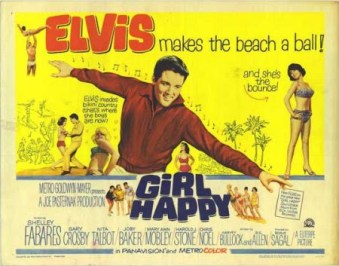
#3 Girl Happy (1965). Like the esteemed Mrs. Miniver, this Elvis movie is another film that I purchased immediately after watching it. I loved it. For years, with the exception of Viva Las Vegas (my favorite Elvis movie), I wrote off Elvis’ movies as pure fluff, and not fluffy in a good way, and many of Elvis’ movies are ridiculous, like Girl Happy, but if you can suspend disbelief and just go along with whatever plot is presented, I’ve found that many of Elvis’ movies are enjoyable diversions. In Girl Happy, Elvis plays a musician (a premise setting up lots of opportunities for Elvis to sing) who, along with his band, is hired by his boss to indirectly chaperone his 18-year old daughter, Shelley Fabares. Shelley is traveling to Florida for Spring Break and her overprotective father is worried. Elvis happily agrees, because he gets an all expenses paid trip to Florida. Like how most movies with this plot go (see Too Many Girls), Elvis starts to fall in love with the girl whom he’s chaperoning, and the girl discovers that he was hired to watch her and gets upset. Regardless, this movie was charming, fun, and I loved it.

#4 History is Made at Night (1937) This was a movie that I’d never even heard of until I heard that Criterion was restoring it and releasing it as part of their esteemed (at least among the boutique label community) line of films. I first watched it on the Criterion Channel and must have seen a pre-restoration print, because it was pretty rough. After watching it, I couldn’t believe that I’d never heard of it. It had one of my faves, Jean Arthur! And Charles “LUCY! RAWWWR” Boyer. How has this movie been hiding from me this entire time? In this movie, Jean Arthur plays Irene, a woman who leaves her husband, Bruce, (Colin Clive) after he falsely accuses her of having an affair. To prevent the divorce from being finalized, Bruce tries to manipulate a situation to frame Irene for infidelity. He hires his chauffeur to pretend to be Irene’s lover, so that a private detective walks in and catches them in a compromising position. While this is taking place, Paul (Charles Boyer) is walking by Irene’s window. He overhears the ruckus and comes to Irene’s rescue, pretending to be an armed burglar. It’s a weird set-up, but ultimately leads to a beautiful love story with an ending that I was not expecting.

#5 Naked Alibi (1954). This was another film noir that I’d never heard of until I was reading Sterling Hayden’s filmography and discovered that he’d made a film with one of my faves, Gloria Grahame. Fortunately, my library had this film available and I was able to borrow it. This was a great movie. Hayden plays a police chief who tails a suspect, Willis, to Mexico. Willis is suspected to be the mastermind behind a series of crimes in the small town from which he and Hayden hail. While in a border town on the Mexican border, Hayden meets Grahame, a singer with whom he becomes smitten. Unfortunately, Grahame is the girlfriend of Willis, despite the shoddy treatment she receives from him. Hayden and Grahame’s connection with one another continues to grow until the very end of the film. This was a wonderful film and I thought that Gloria Grahame looked absolutely gorgeous.

#6 Dead End (1937). Despite the appearance of the Dead End Kids, whom I cannot stand (I don’t get their appeal), I thought this was a great movie. This film is a story about social classes and the privileges that are afforded to those of a higher social standing. The neighborhood in the film is a “dead end” both figuratively and literally. The rich live in high rise apartments that overlook the slums and tenements. Those who are not privileged to live in the high rises literally have the rich looking down upon them. If you have the misfortune to be born into the slums, it is all you can do to get out. Some try to do so honorably, like Dave (Joel McCrea), who dreams of making a career as an architect. However, he can’t just seem to book the right gig, so he has to survive by doing odd jobs. Others, like Drina (Sylvia Sidney) have slightly less honorable means to get out of the tenement, she wants to marry a rich man. Then, there are those like Hugh “Baby Face” Martin (Humphrey Bogart), who did manage to get out of the slums, but he did so by becoming a big-time mobster. The Dead End Kids represent the next generation who most likely will remain in the slums, unless they can somehow be guided into making a better life for themselves. Marjorie Main has a heartbreaking role as Baby Face’s mother. Claire Trevor is fantastic as Baby Face’s old girlfriend, who was never able to get out of the slums.

#7 Klute (1971) This was the first film in Alan J. Pakula’s “Paranoia Trilogy,” which unfortunately I watched all out of order. I don’t think the films in the trilogy have anything to do with one another, so I think I’m okay. Anyway, there’s just something about the 1970s thrillers that I find fascinating. There’s a grittiness, a seediness, combined with the earth tones aesthetic that I just love watching. Anyway, in this film, Jane Fonda gives an Oscar-winning performance as Bree Daniels, a prostitute who aids police detective, John Klute, in investigating a murder. After finding an obscene letter addressed to Bree in the murder victim’s office, Klute rents an apartment in Bree’s building and begins tracing her. Concurrently, Bree is working as a freelance call girl to support herself while she tries to make it as a model/actress. Bree is also trying to find meaning in her life through sessions with a psychiatrist. This was such a fantastic movie and I was on the edge of my seat waiting to find out who was responsible for the murder.

#8 Thunder on the Hill (1951) I am a big fan of Ann Blyth and this was a film of hers that I hadn’t heard of until I purchased Kino Lorber’s Film Noir: The Dark Side of Cinema box sets. Thunder on the Hill, by the way, is on the second collection in the series. In this film, Blyth plays Valerie, a young woman convicted of murder and sentenced to be hanged. However, on her way to the gallows, Valerie and the police officers accompanying her, are forced to spend the night in the hospital ward of a convent due to massive flooding. Running the hospital ward is Sister Mary (Claudette Colbert), a woman who is also battling with her own mental troubles involving her sister’s suicide. Valerie is understandably combative and angry, but confides to Sister Mary that she is innocent of the crime of which she was convicted. Sister Mary, who has been warned in the past about meddling in other people’s affairs, is convinced of Valerie’s innocence and sets to save her before she is executed. This was such a wonderful film. It was interesting to see Blyth in such a different role than that of Veda in Mildred Pierce or the mermaid in Mr. Peabody and the Mermaid. I loved the suspense of the story and the cinematography was gorgeous. I am also a big fan of Douglas Sirk, so this film fit the bill.

#9 King Creole (1958) A second Elvis film on the list? Yes! I watched a lot of Elvis movies this year according to LetterBoxd, so it was bound to happen. This was an excellent film. It was much higher brow fare than Elvis would be offered once he returned from his stint in the army. In this movie, Elvis plays super senior Danny, who has failed high school once and looks like he’ll fail it again due to his behavior. He is offered a chance to graduate if he agrees to take night classes, but Danny turns it down, much to the chagrin of his father, Dean Jagger. There is drama between Danny and his father, in that Jagger lost his job as a pharmacist after his wife died. The family is forced to leave their nice home outside of New Orleans for a much more modest flat in the French Quarter. To help make ends meet, Danny was working before and after school. Now with school out of the way, Danny starts working at a club. As how most Elvis movies go, he is coerced into singing and is offered a job performing at the club, much to the chagrin of the club’s main act. Danny is soon a sensation. Eventually his connection with the local gangs threaten to affect his family, his relationship with a young woman named Nellie (Dolores Hart), and his life. This was such a great movie with a stellar cast. Aside from Elvis, Dean Jagger and Dolores Hart, Carolyn Jones, Walter Matthau, Vic Morrow, and Paul Stewart also star in this film… and it was directed by none other than Michael Curtiz!

#10 Private Lives (1931) This was a fabulous pre-code starring Norma Shearer and Robert Montgomery. In this film, Shearer and Montgomery play Amanda and Elyot, two ex-spouses who end up staying at the same hotel while honeymooning with their new respective spouses. Both honeymoons are NOT going well. Amanda and her new husband Victor (Reginald Denny) are already fighting due to Victor’s incessant need to talk about Elyot. Because yes, let’s talk about your new bride’s ex-husband on your honeymoon. Great idea, Victor. Elyot is dealing with the same thing from his new wife, Sybil (Una Merkel) who won’t stop asking about Amanda. Eventually, Amanda and Elyot find each other and begin to reminisce about “the old times.” They end up leaving the hotel together and head to a new place in St. Moritz. This was a fabulous pre-code that had plenty of racy moments. I am not as big a fan of Shearer in her production code movies like The Women, but I love her in pre-code. She and Montgomery also make a great pairing. Poor Una Merkel is wasted in her role, but she is wonderful in her scenes.

#11 Hold Back the Dawn (1941) This was an amazing movie. One that I’d always wanted to see but it seemed like it was never on TCM–then finally it was and the movie was everything I’d hoped it would be. In this film, Charles Boyer stars as Georges Iscovescu, a Romanian immigrant who is stuck in a Mexican border town. Per immigration laws, he is looking at up to an eight year wait to obtain a quota number for entry in the United States. Georges then runs into an old flame, Anita Dixon (Paulette Goddard), an Australian who married a US citizen purely to obtain US citizenship. As soon as she could, she divorced the man and retained her citizenship status. Anita suggests that Georges do the same thing, then he and she could be free to start a new life together in New York. Georges immediately goes to work and spots Emmy Brown (Olivia de Havilland), a California school teacher whose bus has broken down. The bus is set to be repaired shortly, but Georges manipulates the situation (by “losing” a vital piece of the bus’s machinery) and forces Emmy and her class to stay overnight. This gives Georges enough time to woo Emmy and they are married after a whirlwind romance. However, Georges is required to wait in Mexico a few weeks before he can join Emmy in California. Emmy returns unexpectedly and Georges takes her on a trip (under the guise of a honeymoon, but in reality he is trying to hide from an immigration officer who is looking for con artists like Georges and Anita). Georges’ plans are complicated when he finds himself falling in love with Emmy. This was such an amazing film. Even though we’re supposed to dislike Georges, it’s hard to do because it’s Charles-freaking-Boyer. It’s easy to see why Emmy falls for him. I love true, legitimate romantic films (with no contrived plot points), and this is one of the best that I’ve seen.

#12 Gaslight (1944) Another Charles Boyer film! Third one on the list! Surprisingly Boyer was not on my top 10 actors watched in 2021, per Letterboxd. This was an amazing film. I don’t know how I went so long without seeing it. This is the film that gave the name to a form of psychological abuse, where one partner mentally manipulates another into thinking that they’re losing their mind. In this film, Boyer plays Gregory Anton, a pianist who marries Alice Alquist (Ingrid Bergman), a famous opera singer. Gregory works as Alice’s accompanist. At first, Gregory seems sweet, he convinces Alice that they move into her deceased aunt’s old home #9 Thornton Square in London, seemingly under the guise that Alice loved her aunt so much and that her aunt would want her home to be lived in. However, Gregory has ulterior motives which are revealed throughout the film. To keep Alice from catching onto Gregory’s motives, he gaslights her by manipulating situations and then making her think she caused them. Alice begins to think she’s going insane. And while she begins to question Gregory’s actions, he’s gotten her mind so messed up that she can’t convince herself that she’s right. A young, 17-year old Angela Lansbury makes her film debut as Nancy, a tart of a maid who takes pleasure in observing Gregory’s manipulation of Alice. Nancy even plays along to exacerbate the situation. Ingrid Bergman’s performance was a tour-de-force and she deserved every piece of the Oscar that she received.

#13 I Want to Live! (1958) If there are two things I love, it’s classic film and true crime. I Want to Live! has both. This film is a biopic of Barbara Graham, a prostitute who was executed in California in 1955 for her part in the murder of a wealthy widow. Susan Hayward gives an Oscar-winning performance as the doomed woman who at the beginning of the film, works as a prostitute who is arrested for soliciting sex across state lines. She then receives jail time after providing a false alibi to two friends who committed crimes. Despite her growing rap sheet, Barbara continues to “make a living” by committing petty crimes and turning tricks. Eventually, she hits the big time when she gets a job working with a big time thief, Emmett Perkins. Her job is to lure men into his illegal gambling parlor. Meanwhile, her husband has a drug addiction and is unemployed–leaving Barbara as the breadwinner. Eventually Perkins ends up becoming involved with criminals, John Santo and Bruce King. Barbara returns to Perkins’ establishment which is soon raided by the police. Barbara surrenders to the police for her involvement in the gambling ring, but soon learns that she is being accused in being complicit with Santo and King’s murder of a wealthy widow. Barbara tries to give her alibi, saying that she was home with her husband and son, but her husband has skipped town. Unless he can be found, Barbara is toast. This was such an amazing film. I know that there was controversy regarding how Barbara Graham was portrayed in the film, versus the real life events. I can’t comment on that; but what I can say is that real facts or not, this was a great movie.

#14 Suspense (1946) I went into this film noir not knowing entirely what to expect. It starred Barry Sullivan whom I like and Albert Dekker who always turns in a good performance. Sullivan and Dekker’s co-star was British figure skater, Belita. Often when athletes are put into films, especially athletes whose sport is exploited on screen, the results can vary drastically–especially if the athlete has limited acting talent. Sometimes this is good, such as the case with Johnny Weissmuller in the Tarzan series. Other times, it can be limiting like is the case with Belita in another film of hers that I’ve seen. However, in this film, I was pleasantly surprised. I’m not saying Belita was amazing; but she was asked to play a figure skater, and Belita delivers on that front. In this film, Sullivan plays schemer, Joe Morgan, a newcomer to New York City who ends up taking a job at a theater as a peanut vendor. Belita plays the star performer, figure skater, Roberta. Albert Dekker plays Leonard, the owner of the theater and Roberta’s husband. Joe ends up suggesting a new act for Roberta, which revitalizes the show–as a reward he is made a manager. When Leonard leaves for a business trip, he puts Joe in charge. Joe and Roberta end up striking up a romance which Leonard soon discovers. This was a fantastic film. I actually was in suspense and couldn’t wait to see what would happen next.

#15 The China Syndrome (1979) This was another 1970s thriller that I watched which I really enjoyed. In this film, Jane Fonda plays television reporter, Kimberly Wells, who keeps getting stuck with the fluff stories during the local news segments. There is chauvinism present at the station, as it is thought that she couldn’t possibly handle a serious story. Her cameraman is the hot-tempered Richard Adams (Michael Douglas). One day, Kimberly and Richard end up getting a plum gig: doing a report from the Ventana, CA nuclear power plant. While visiting, they witness a malfunction in the nuclear power plant turbine operation and emergency shutdown protocol. Richard, despite being asked not to film, covertly records the entire incident. The incident is played off as not a big deal, but it becomes clear that the plant was thisclose to a meltdown. Jack Lemmon gives a fantastic performance as Jack Godell, the supervisor of the plant. Wilford Brimley was also excellent as the long-time employee, Ted Spindler, who battles with knowing what is right and his resentment over being passed up for promotion opportunities. I loved this movie. This isn’t normally my type of thing, but as a fan of 1970s thrillers and Fonda and Lemmon, I gave it a try. I’m glad I did. I was captivated from beginning to end and I especially loved Lemmon’s performance in the second half of this movie.

Honorable Mentions:

  1. A Cry in the Night (1956). Raymond Burr, Natalie Wood, Edmond O’Brien.
  2. Jane Fonda in Five Acts (2018). A fabulous documentary on HBO Max.
  3. The Caine Mutiny (1954). Humphrey Bogart, Fred MacMurray, Van Johnson, Jose Ferrer.
  4. Once a Thief (1965). Alain Delon, Ann-Margret, Van Heflin.
  5. Walk on the Wild Side (1962). Laurence Harvey, Jane Fonda, Barbara Stanwyck, Anne Baxter, Capucine.
  6. Moonrise (1948). Dane Clark, Lloyd Bridges, Gail Patrick.
  7. The Glass Wall (1953). Vittorio Gassman, Gloria Grahame.
  8. The Big Combo (1955). Richard Conte, Cornel Wilde, Jean Wallace.
  9. Muppets Haunted Mansion (2021) The Great Gonzo, Pepe, Will Arnett.
  10. Die Hard (1988) Bruce Willis, Bonnie Bedelia, Reginald VelJohnson.
  11. Confession (1937) Kay Francis, Basil Rathbone, Ian Hunter.
  12. Three Days of the Condor (1975) Robert Redford, Faye Dunaway, Max Von Sydow, Cliff Robertson.
  13. I’ll Cry Tomorrow (1955) Susan Hayward, Richard Conte, Eddie Albert.
  14. Possessed (1947) Joan Crawford, Van Heflin, Raymond Massey
  15. The Circus (1928) Charlie Chaplin.
Categories
Blogathon Favorite Classic Movies (Pre-1980) Favorite Perfomers

What a Character! Blogathon–Elisha Cook Jr.

WILMER COOK: Keep on riding me and they’re gonna be picking iron out of your liver.

SAM SPADE: The cheaper the crook, the gaudier the patter.

Elisha Cook Jr. as Wilmer Cook and Humphrey Bogart as Sam Spade in “The Maltese Falcon.”

HELEN: I must warn you though, liquor makes me nosy. I’ve been known to ask all sorts of personal questions after four cocktails.

MARTY: ‘s alright. I’ve been known to tell people to mind their own business. Cold sober too.

Claire Trevor as Helen and Elisha Cook Jr. as Marty in “Born to Kill.”

GEORGE PEATTY: This couple, sittin’ in front of me, oh, they weren’t young, exactly. I guess the woman was about your age.

SHERRY PEATTY: A little senile, you mean? With one foot and a big toe in the grave?

GEORGE PEATTY: You want to hear this or not? Do you or not, Sherry?

SHERRY PEATTY: I can’t wait. Go ahead and thrill me George.

Elisha Cook Jr. as George Peatty and Marie Windsor as Sherry Peatty in “The Killing.”
“Well Wilmer, I’m sorry indeed to lose you. But I want you to know I couldn’t be fonder of you if you were my own son. But well, if you lose a son, it’s possible to get another. There’s only one Maltese Falcon.”

Elisha Cook Jr. carved out a very unique niche for himself in Hollywood. He often played a villain, but never a outwardly scary villain. He was no Tommy Udo (Richard Widmark) in Kiss of Death or Max Cady (Robert Mitchum) in Cape Fear. Cook Jr.’s portrayal was much different. He was mild-mannered, timid even, but was still able to make the action of the film seem uncomfortable. To me, he comes across as someone who seems like they could crack any time now. In The Maltese Falcon, he trails Sam Spade all over San Francisco and makes threats along the way, but Spade never takes him seriously. Even at the end of the film, Cook Jr.’s boss, Kasper Gutman, sells him out and makes him the fall guy. Kasper does this to save his own neck.

When I first learned about Elisha Cook Jr., I did what I always do for every new film and new actor I discover: I looked up his Imdb and Wikipedia pages. I was astonished to learn that Cook Jr. was born in 1903! 1903! In ‘Falcon,’ he looks like a kid compared to Bogart and company. However, he was only four years younger than Bogart! Save for Sydney Greenstreet, Cook Jr., was older than the other members of his gang: Mary Astor and Peter Lorre. This was insane to me. He had such a baby face that it was astonishing that he was almost 40 when he appeared in ‘Falcon.’

It is partially Cook Jr.’s baby face that lends to his ability to play these meek, timid characters who provide a duplicitous nature to his characters. He didn’t always play the villain, but he often played someone who was pretty much on the up-and-up, but got in over his head due to his naiveté and inability to stand up against a stronger personality. In The Killing, Cook Jr., works at a large horse track as a cashier. He is married to the very domineering (physically and personality-wise) Marie Windsor, who treats him like garbage because he hasn’t provided her with the lifestyle to which she feels accustomed. To make his wife like him better, Cook Jr., gets involved with criminal Sterling Hayden who wants to pull off one last heist. Cook Jr., offers to use his position as an employee of the horse track to help Hayden pull off the heist. In exchange, he is supposed to receive a large sum of money. Unfortunately, Cook Jr. ends up paying for his involvement with his life.

Probably the most action Elisha Cook Jr. ever got in one of his films–Phantom Lady.

In contrast to his wimpy weaklings, Elisha Cook Jr., did turn in a very uncharacteristic (yet entirely typical) performance in Phantom Lady. In this film, Ella Raines is trying to prove the innocence of her boss who is sitting on death row for murdering his wife. He has an alibi, but the alibi cannot be located. Raines is trying to follow the clues to find the alibi and exonerate her boss before it’s too late. Nightclub drummer Cook Jr., is one of the people who can help lead her to the alibi. To convince him to give her the details, Raines tries to emulate the type of woman that a musician would be interested in. Donning fishnet stockings, a slinky dress, and stilettos, hepcat Raines’ ruse works. Cook Jr., invites her to this seedy private club away from the nightclub.

Here’s where Cook Jr.’s uncharacteristic performance comes in. Obviously wanting to seduce Raines and “make it” (as they say in old movies back then) with her, he presents the most erotic, sexually charged drum solo ever committed to celluloid. This is as close as filmmakers could get in having characters have sex on screen in 1944. Cook Jr.’s drumsticks hit the drumheads with such an intense, rhythmic beat. Close-ups of his sweaty face, eyes widening, smile tightening are juxtaposed with shots of the drumsticks. As the beat intensifies, so does the intensity in Cook Jr.’s face until the scene climaxes, and he and Raines slink out the door when she offers a come hither look. Like in most of his films, Cook Jr., doesn’t survive Phantom Lady, but at least he had some fun before his murder.

Elisha Cook Jr. is one of my favorite character actors. He brings such a unique presence to screen and you never know what you’re going to get, while knowing exactly what you’re going to get when he’s on screen.

My favorite Elisha Cook Jr. performances:

  • The Maltese Falcon
  • The Killing
  • Born to Kill
  • Phantom Lady
  • House on Haunted Hill
  • The Big Sleep
  • The Gangster
  • Don’t Bother to Knock
  • Love Crazy
  • I Wake Up Screaming
  • Ball of Fire

WATSON PRITCHARD: They’re coming for me now… and then they’ll come for you.

Elisha Cook Jr. as Watson Pritchard in House on Haunted Hill