King of the Hill is a newer topic than what typically write about on this blog, but I love this show so much and this episode so much, that I have to write about it. “Dances with Dogs,” which originally aired on December 1, 2002 is hysterical. It has such a ridiculous plot: Bobby Hill wants to enter the “Musical Canine Freestyle,” a dog-dancing contest which is a sensation in Canada.
At the start of the episode, Bobby watches as his parents, Hank and Peggy Hill, leave to get ice cream. He’s been waiting for his parents to leave, so he can practice dog dancing for an upcoming contest with Hank’s beloved 13-year old Bloodhound, Lady Bird (named after the first lady, Lady Bird Johnson). Bobby puts on The Beatles’ rendition of “Twist and Shout” and starts practicing. However, then Hank and Peggy come home unexpectedly after Hank is incensed that the employee put his fingers in his ice cream and killed his mood for ice cream. Hank, who seems perpetually embarrassed by free-spirit Bobby’s actions, is horrified to see his son dancing with the old Lady Bird. “She’s got arthritis!” Hank says.
Bobby, needing a new dog to dance with, goes next door to neighbor Kahn Souphanousiphone’s home and asks if he can dance with their West Highland Terrier, Doggie, in the upcoming contest. Kahn agrees, but Bobby has to clean up Doggie’s poop in their yard. Bobby agrees. Meanwhile, Hank realizes that Lady Bird seems to be benefiting physically from dancing. He decides that he’s going to enter the dog dancing contest. Hank chooses Patsy Cline’s “Walkin’ After Midnight” as his and Lady Bird’s song.
Hank and Lady Bird
Hank then walks in on Bobby practicing with Doggie and is upset that he’s dancing with neighbor Kahn’s dog. This scene brings the funniest exchange in the entire episode:
HANK: You’re dancing with the neighbor’s dog against me and Lady Bird?! BOBBY: Well what was I supposed to do? Not dance with a dog?! Anyway, you said Lady Bird was too old to dance. If you pumped her full of pain pills, I’ll make sure you’re both disqualified. HANK: Well, what do you care? Looks like you’ll dance with any dog that will have you!
Bill and Rex
Hank and Bobby continue bickering and trash talking each other about dog dancing, with Hank being offended that Bobby would deign to dance with Kahn’s dog. Eventually Peggy, my queen, has had enough:
PEGGY (to HANK): You both want to dance with dogs. You each have a dog you can dance with. You take your dog to the garage. You dance with her there. Bobby gets to dance with his dog in his bedroom. Everybody gets to dance with a dog. Everybody wins.
Meanwhile, Hank’s friend, eternal sad sack Bill Dauterive, decides that he’ll also get a dog to dance with. He ends up buying Rex, an ill-tempered Rottweiler, from an animal shelter. He selects Billy Ray Cyrus’ “Achy Breaky Heart” as their song. However, every time Bill tries to dance with Rex, he ends up being mauled. At the contest, Bill tries to dance with a muzzled Rex and is forced to remove the muzzle.
Bobby and Doggie
On the day of the dog dancing contest, Hank is humbled by Bobby. Hank, thinking that dog dancing is easy, more or less does a very simple slow dance with Lady Bird. Bobby on the other hand, took the dog dancing much more seriously and has choreographed a very impressive routine to Technotronic’s “Move This” with Doggie. Bobby is an excellent dog trainer and has obviously put a lot of work into the contest. The commentators, one being Scott Hamilton as “Sketch Randall,” (the 1984 Olympic Gold Medalist in Men’s Figure Skating), and the other “Dud Jeperson,” are hilarious as they speak in awe about Bobby’s performance.
SKETCH: We are witnessing a dream. I hope I never wake up. DUD: Are they even touching the floor? Amazing!… I don’t even know how to describe that move. SKETCH: I wish everyone who denies the pure athleticism of dog dancing could see what I’m seeing now.
Eventually, the dog dancing contest comes to an end and the winners for the “Beginners Off-Leash Musical Freestyle” contest are announced. Rhonda Clark and her Border Collie, Rusty take third place. Bobby and Doggie take second. Hank, way too optimistic about his lukewarm performance, assumes that he and Lady Bird will win first. However, Helen Bradley and her toy poodle, Buddy (same first name as my bird!) take first. “It’s a young dog’s sport,” Hank says to console Lady Bird.
This is from “The Apple” (1980). This film is terrible and I could not find any entertainment in it. It was just stupid, and not in a good way.
What makes a good bad movie? For me, it’s simple. An objectively bad movie has to be entertaining. A lot of my favorite good bad movies are extremely campy. Campy films often contain a lot of theatrics and over the top aesthetics. One of my favorite campy films is Valley of the Dolls (1967). Everything in that film is over the top: the sets, the production, the melodrama, and the performances. Patty Duke snarling “Sparkle, Neely, Sparkle” is everything to me. Another of my favorite over the top camp classics is Barbarella (1968) where Jane Fonda travels through space in her ship, complete with floor to ceiling shag carpeting. The production design is out of this world (pardon the pun) as are Fonda’s costumes.
While Valley of the Dolls and Barbarella were “camping up” the theaters in the mid-late 1960s, a camp classic was airing on television–Batman starring Adam West as the Caped Crusader, along with Burt Ward as the “Holy Boy Wonder, Batman” and the ever rotating roster of villains: the Joker (Cesar Romero), the Penguin (Burgess Meredith), Catwoman (Julie Newmar and Eartha Kitt), and the Riddler (Frank Gorshin), to name a few. Appearing as a villain on Batman was a hot commodity in the 1960s–every star wanted the job. The Batman television show is incredibly cheesy with Robin’s constant “Holy [insert thing here] Batman,” all the Bat-gadgets, the slanted photography for the villain scenes, the onomatopoeia Pow! Kapow! type phrases populating the screen during fight scenes…the list goes on. Batman did have a fantastic theme song (Na na na na na na BATMAN!)
Alicia Silverstone, George Clooney, and Chris O’Donnell
In the late 1980s, director Tim Burton brought Batman back to the movie screens–except he didn’t want to follow in the campy footsteps of the 1960s Batman. His version starred Michael Keaton and Jack Nicholson as Batman and the Joker, respectively. The film has a decidedly darker tone than the 1960s television show, albeit Nicholson is given some wacky scenes to play after he is disfigured and becomes the Joker. Burton and Keaton were back in 1992 with Batman Returns, this time bringing Danny DeVito and Michelle Pfeiffer in as the Penguin and Catwoman. The darker tone remained.
After Batman Returns failed to turn as large of a profit as Batman due to it being deemed too dark and scary for children (though I saw it in the theater in 1992 at the age of 8), Warner Brothers decided they wanted the series to move in a different direction. This “different direction” saw the removal of Burton and the entrance of Joel Schumacher. Michael Keaton also declined to return as he was not interested in appearing in this new interpretation of Batman. Schumacher used the 1960s Batman as one of his main influences for the reimagining of the series.
Arnold Schwarzenegger and Uma Thurman
Batman Forever was released in 1995 with Val Kilmer as Bruce Wayne/Batman. Dick Grayson/Robin was introduced in this installment with Chris O’Donnell in the role. Nicole Kidman played Batman’s love interest, Dr. Chase Meridian. The villains were Tommy Lee Jones as Harvey Dent/Two-Face and Jim Carrey as Edward Nigma/The Riddler. I also saw Batman Forever in the theater and I just saw it again in the theater last year for the film’s 30th anniversary. I have to say that this film is so over the top, but Carrey is incredibly entertaining. I actually really like this movie. Batman Forever was a huge hit, so obviously a sequel was coming.
It took me too long to get to this point, but here we go. The fourth film in the series, Batman & Robin, was released in 1997. This installment in the series is famously known as the one featuring the Batsuit with nipples. The film starred George Clooney (then a star on ER and was looking to make his transition to film) as Bruce Wayne/Batman. Chris O’Donnell returns as Dick Grayson/Robin. Clueless star, Alicia Silverstone plays Barbara Wilson/Batgirl. The villains are Arnold Schwarzenegger as Dr. Victor Fries/Mr. Freeze and Uma Thurman as Dr. Pamela Isley/Poison Ivy. I also saw Batman & Robin in the theater and hadn’t watched it since–until last night when I watched it again. Oof. This film is terrible, but also incredibly funny and entertaining because it’s so bad. Going into the film, the only thing I could remember from my original watch was that at one point, Robin was wearing fake lips. Then I started questioning myself: Am I hallucinating? Did that really happen? It seems so stupid. But then, the film started and I realized that this film is just stupid enough that Robin wearing fake lips seems like the most realistic thing that could happen in this film.
Poison Ivy is easily the best part of this film.
Right off the “bat” (pardon the pun as there are a lot of them in Batman & Robin), the opening sequence is already making the audience laugh. Close-ups of Batman’s butt and crotch are shown repeatedly as he suits up to fight crime in Gotham City. In Batman Forever, there was a shot of Val Kilmer’s butt in the Batman costume, but for some reason in the context of that film, it was funny. In Batman & Robin however, it seems almost gratuitous and unnecessary. Even worse, we have to endure the same shots with Robin’s butt and later Batgirl’s. Enough already, Schumacher.
Within minutes of the film’s start, it becomes glaringly obvious that the Batman & Robin script is terrible. I can’t believe that stars of Clooney or Thurman’s stature would read this and think “this sounds great.” Mr. Freeze and Poison Ivy only speak in one-liner ice or plant puns. The opening action sequence with Batman and Robin starts with Robin repeating Batman’s funny line from Batman Forever when he says “Chicks dig the car.” Robin, it was funny when Kilmer’s Batman said it. It was not funny when you said it, because you are annoying.
Here are some hilariously awful Mr. Freeze and Poison Ivy quotes:
(Do your best Arnold Schwarzenegger impression when imagining Mr. Freeze saying these things. It makes it even funnier)
MR. FREEZE: What killed the dinosaurs? The Ice Age!
MR. FREEZE: Let’s kick some ice!
MR. FREEZE: Allow me to break the ice. My name is Freeze. Learn it well, for it’s the chilling sound of your doom.
MR. FREEZE: Mercy? I’m afraid my condition has left me cold to your pleas of mercy.
MR. FREEZE: Freeze in hell, Batman!
POISON IVY: ‘Cause it’s not nice to fool Mother Nature (because when they’re not speaking in one-liner puns, they’re using commercial slogans)
POISON IVY: There’s just something about an anatomically correct rubber suit that puts fire in a girl’s lips.
POISON IVY: Come join me. My garden needs tending.
POISON IVY: Some lucky boy’s about to hit the honey pot.
Honorable Mention to this exchange between ROBIN and POISON IVY:
ROBIN: Is your thumb the only part of you that’s green?
POISON IVY: You will just have to find out!
ROBIN: I want us to be together but, I also wanna make sure you’re serious about turning over a new leaf… I need a sign.
POISON IVY: How about “Slippery When Wet” ?
To their credit, Arnold Schwarzenegger and Uma Thurman seem to be having fun with their roles, especially Thurman. Their scenes, complete with the terrible pun-laden dialogue are the reason to watch this film. I can’t say the same for the heroes of the film. Clooney looks like he’s regretting every moment of his life leading to his participation in the film. He is a good actor, but that’s not apparent in this film. Chris O’Donnell is incredibly irritating as Robin. Robin will just not quit whining to Batman about not being allowed to do things on his own and being seen as an equal partner. It’s obvious why the planned Robin/Nightwing sequel with O’Donnell was never made. There are some hackneyed scenes that seem to repeat over and over throughout the film with Batman trying to offer some sort of wisdom and lessons to Robin, but they just seem lame and contrived.
“Let’s kick some ice!” is easily my favorite of Mr. Freeze’s ice puns.
The scenes with Batgirl are even worse. I love Alicia Silverstone in Clueless and Blast From the Past, but she is out of her element in an action film. The scene with Batgirl trying to intimidate Poison Ivy with trash talk is laughable and absurd. Batgirl’s trash talk scene would have been the perfect place in the script to insert some plant puns. Batgirl could have said something like “Time to weed the garden” or “I’ll give you a ‘Round-Up’ kick to the face” or something. In Clueless, Silverstone showed that she could deliver sass or trash talk to Paul Rudd, but that’s because she has a good script. Batman & Robin has an awful script, so she’s left with lame trash talk accusing Poison Ivy of setting back feminism. Batgirl and Poison Ivy’s fight scene looks like it was done in slow motion. I would have loved to have seen Poison Ivy fight Mr. Freeze. The film also inexplicably changes Batgirl’s character from Commissioner Gordon’s daughter to Alfred’s niece! I’m sure this was done out of convenience so it would explain why Batgirl is staying at Wayne Manor.
Making matters even worse is that Batgirl is more or less a copy of Robin from Batman Forever. She even has the same tragic orphan storyline that both Batman and Robin have. She randomly likes to steal Robin’s motorcycle at night to enter races against rough characters in the city. Nothing about Batgirl even hints at her being a “bad girl.” Even worse is that the film tries to make the claim that Batgirl is a computer genius. However, the only attempt that the film makes to show her computer genius is a scene of her trying to guess Alfred’s computer password by looking around his room for ideas. That is not the sign of a computer genius. They should have shown her creating some hacking device, entering a DOS command to bypass the password screen, or inserting some sort of disk to download data, something more clever. The film also uses some poor CGI to project the computer screen onto Batgirl’s face, which would not happen. The film also tries to make Robin and Batgirl seem like they’re going to become romantically involved, but the two seem to hate each other–maybe because they’re too much alike. There really is no point to the Batgirl character in this film.
However, I don’t want to completely dump all over Alicia Silverstone in this film. It’s not her fault that the script is so bad. I remember the magazines and tabloids being so cruel to Silverstone during the film’s production and theatrical release. There were countless horrible headlines dubbing her “Fatgirl” which is so off the mark it’s laughable. There is not a single moment in Batman & Robin where Silverstone is even remotely close to looking fat. No wonder “heroin chic” was a popular look in the 90s.
A laughably terrible fight sequence between Ivy and Batgirl.
Despite my article completely ragging on Batman & Robin for being so awful, it is also entertaining because it’s so awful. The script is horrendous. It might be the worst script ever produced. If it’s not *the* worst, it’s up there. The film’s special effects are also terrible, even for the 90s. Mr. Freeze’s blue freeze rays reminded me of Vincent Price and Boris Karloff’s magic fight in the 1963 version of The Raven. Mr. Freeze also has an amazing moment where I empathized with him when he freezes a guy for talking during a movie. I loved when Batgirl “wins” the fight against Poison Ivy by knocking her into a large, carnivorous plant. This film is entertaining for the bad script full of plant and ice puns and commercial slogans, as well as the weak attempts at trash talking and for Robin’s fake mouth. Did I mention that the script sucks?
The Brady Bunch (1969-1974) is an American pop culture icon. Even the most layman television fan can hear famous lines like “Marcia, Marcia, Marcia!” or “porkchops and applesauce,” or “Oh! My nose!” and not only know where the quote originates from; but even know which character uttered the line. The Brady Bunch sometimes gets a bad rap for being corny and unrealistic. Frankly, I love The Brady Bunch for those reasons–which is why I love The Brady Bunch Movie (1995) and A Very Brady Sequel (1996). I may have seen both films in the theater in middle school when the movies were new!
The movie cast recreates the iconic opening credit sequence.
The Brady Bunch Movie did a very good job with casting actors who somewhat resemble their television predecessors. Carol (Shelley Long) has Florence Henderson’s iconic flip/shag mullet ‘do. She wears a lot of brightly colored and patterned pantsuits. Carol puts absurd amounts of sugar in her coffee and constantly says “Oh Mike!” throughout the film. Gary Cole plays Mike Brady and while he doesn’t look exactly like Robert Reed (original Mike Brady), he has his style of speaking down to a T. Mike is very adept at always having a lesson at the ready, whether it’s something short like “when you tattle on others, you’re really tattling on yourself. You’re saying ‘I’m a tattletale'” or a more long-winded lecture, such as when he lectures Greg on not wanting to take part in the Search for the Stars Contest. Henriette Mantel, while she doesn’t really look like Ann B. Davis, she sounds similar to Alice and does a good job emulating her way of speaking. I also love how Alice’s formal dress looks like a fancier version of her maid uniform; but it’s the same thing. Even Ann B. Davis wears a powder blue jacket with buttons in the same arrangement in her cameo scene.
The Brady kids are varying levels of successful in terms of portryal with the standout being Jennifer Elise Cox as the perpetually overshadowed and ignored Jan. Eve Plumb gave us a very memorable portrayal of middle child Jan, who constantly feels inadequate next to her popular sister Marcia. Jan provided The Brady Bunch‘s most iconic quote: “Marcia, Marcia, Marcia!” Christine Taylor as Marcia is the second best character in the film. She is a dead-ringer for Maureen McCormick. She also is adept at mimicking some of McCormick’s odd pronunciations, “skewl” (school) being one of the most memorable.
Christopher Daniel Barnes plays oldest child Greg. He is most known for providing the voice of Prince Eric in 1989’s The Little Mermaid. He looks somewhat like Barry Williams and does a good job acting like the “Casanova of Clinton Avenue.” Paul Sutera plays middle son, Peter, memorably played by Christopher Knight in the original. Jesse Lee and Olivia Hack play Bobby and Cindy Brady, recreating the parts played by Mike Lookinland and Susan Olsen in the original series.
The Brady Bunch Movie presents a satirical look at our favorite 1970s family and plops them down in 1995 Los Angeles. The Bradys still live in their iconic mid-century modern home at 4222 Clinton Way–astroturf lawn and all. There are dozens of references to the original show. As an avid viewer of the television show and a massive fan of the movies, I could list all the references; but that may make this article insanely long to read. One of the main references to the show are the Bradys’ neighbors–Mr. and Mrs. Dittmeyer (Michael McKean and Jean Smart), who were mentioned on one or two occasions in the original series. Carol memorably hooks one of Mr. Dittmeyer’s bags of charcoal when she’s practicing casting a fishing line in the backyard. However, every characters’ respective personality and quirks are played to the hilt for laughs.
While The Brady Bunch television show is often criticized for being unrealistic in its tackling of non-issues like breaking mom’s favorite vase, or having to appear in a television show. This criticism is understandable, especially when it aired alongside shows like All in the Family and The Mary Tyler Moore Show. However, I would argue that having shows about having to wear glasses or braces, or being peer pressured to smoke cigarettes is far easier to relate to than a more timely, 1970s-centric, issue. While some shows from the 1970s seem more dated, The Brady Bunch remains timeless, which is why it still remains relevant today.
However, The Brady Bunch Movie does feature a very serious un-Bradylike issue as its main plot: Mike and Carol are behind in their property taxes and face foreclosure if they can’t come up with $20,000 by the end of the week. Their neighbor, Mr. Dittmeyer, is the villain of the story. He is in real estate development and hates the Bradys. He is trying to convince his neighbors to sell their homes to a developer for a tidy sum. The only hold out are the Bradys. Due to their mail being misdelivered and Mr. Dittmeyer’s opening of the Bradys’ mail, he gets wind of the Bradys’ tax problems. He is only too happy to buy their house at the upcoming auction.
The kids have one of their infamous kid meetings to come up with a plan. Marcia is going to become a model (of course). Bobby and Cindy are going to try and find money around the house. Greg is going to become rock star, Johnny Bravo (obviously), and Peter is going to ask neighbors if they need chores done around their home. Jan’s plan is to enter the $20,000 “Search for the Stars” contest. This is the plan that they ultimately follow through with at the end of the film, and of course because its The Brady Bunch, they win. I love that all the original recordings performed by The Brady Bunch Kids are used in this film.
The Brady Bunch kids perform “Keep On” and win $20,000 to save their home!
The movie also features subplots for the kids, with Jan’s being the most memorable. Marcia accidentally makes two dates for the same night: one with Charlie and the other with “Big Man on Campus,” Doug Simpson. Doug is more interested in getting Marcia into the sack, since despite being the most popular girl in school, she is notoriously “harder to get into than a Pearl Jam concert.” Marcia’s also trying to get Davy Jones of The Monkees to perform at the prom. Greg is trying to become Johnny Bravo, by singing songs like ” ‘Til I Met You” (…clowns never laughed before, beanstalks never grew. Ponies never ran before, ’til I met you…). ” ‘Til I Met You” was co-written by Barry Williams. While the Greg in the television show was made out to be a ladies’ man, this Greg is so lame that girls literally scream and run out of the room.
Peter is going through puberty and also finds himself having a crush on Holly, the grunge girlfriend of his neighbor, Eric. Holly also thinks Peter’s cute “in a Gilligan sort of way.” Bobby becomes the school safety monitor and hates that his job involves ratting out his classmates. Then there’s Cindy. Frankly, the Cindy in this movie is a moron, she looks to be at least 12 but acts 5. She echoes the sentiments of Susan Olsen who hated how ridiculous Cindy acted throughout the series.
Potato sack race!
Finally, there’s Jan. Jan is so awesome and has the best subplot of the entire film. First she has to bear the indignity of having to wear glasses–saying that “glasses make [her] look positively goofy.” Then, she is mistaken for Marcia at school. Jan is so tired of Marcia being better than her at everything, she decides to set herself apart. In a scene straight out of the show (except a swap of venue and a more exaggerated sized wig), Jan decides to don a giant black afro wig to the prom, in a desperate attempt to draw attention away from Marcia. Her anxiety over being in constant competition with Marcia starts causing her to hear voices. Jennifer Elise Cox’s portrayal of Jan is worth the admission alone to the film.
“But Jan, you don’t have any friends.” My favorite line from the film. It makes me laugh every time.
In A Very Brady Sequel, the film answers one of the burning questions of the original series: What happened to Carol’s first husband? The original series never addresses what happened to the girls’ father/Carol’s husband. After the second season, the show stops even addressing the fact that the Brady Bunch is a blended family. Carol even makes comments about the boys inheriting traits from her!
Alice dusts the iconic horse statue in the original series.
The film starts with Trevor Thomas (Tim Mattheson) and Carol’s husband Roy Martin on a boat. Roy has a rare (i.e., expensive) statue in his possession and tells Trevor that he sent it ahead to his wife, Carol. Trevor and Roy’s ship then wrecks and Roy dies. Trevor spends the next decade or so trying to find where Roy’s wife, Carol lives. He finally tracks Carol down at the Brady home and introduces himself as Roy Martin. Carol and the girls are understandably shocked. Roy then spots the rare statue in the Bradys’ home–it’s the horse statue which was seen on a sideboard in the Bradys’ living room next to the famous stairs.
The Brady Kids take Trevor shopping and make him over into a horrendous looking vintage suit!
Like in the first film, there are numerous subplots involving the other characters in the film. The family is getting ready shopping and planning for Mike and Carol’s upcoming wedding anniversary. In an ode to another memorable episode, Greg and Marcia fight over the newly remodeled bedroom in the attic. In the show, Greg won the attic using the argument that he was older and was graduating the next year. In the movie however, both Marcia and Greg are given the room, with the idea that they’d share. However, when you have two opposite sex teenagers, technically not related, sharing a bedroom… Don’t get me wrong, Greg and Marcia don’t hook up; but they find themselves having very awkward feelings about each other. This entire subplot is an allusion to the real-life romance between Greg and Marcia’s original actors, Barry Williams and Maureen McCormick, who dated during season 4 and into season 5. There are many season 4 episodes where you can see Greg making cow eyes at Marcia.
Marcia and Greg are double dating (with other people, not each other) and get way too excited talking about Marcia’s hair care regimen.
In A Very Brady Sequel, Jan’s neurotic behavior continues when she invents a fake boyfriend named George Glass. Jan in the television series also made up a fake boyfriend named George Glass, but she didn’t go to the extent of making a dummy and pretending to be with him. Jan is so desperate to be seen as desirable that she hilariously calls a 1-900 hotline to speak to a “live guy.” Peter, Bobby and Cindy don’t have that exciting of storylines. Peter starts to idolize Trevor which concerns Mike. Bobby and Cindy start a “detective agency” and end up discovering that Trevor isn’t who he says he is. This leads to Trevor kidnapping Carol and taking her to Hawaii where he can meet with Professor Whitehead to sell the horse statue. As we all remember, in the television show, Vincent Price played the infamous Professor Whitehead who kidnaps the boys and ties them to large statues in his cave. There’s also the hilarious tiki statue and great “DO DO DO DOOOO” music that makes an appearance.
A Very Brady Sequel pays homage to the pilot episode of the television shows with Carol’s gold dress and the girls’ pink dresses. Mike and the boys however do not don pink paisley suits in the show.
The sequel isn’t nearly as good as the first film; but it is still funny and worth watching. The first film feels more cohesive, and all the references feel more organic. In the second film, all the in-jokes seem more forced, as if the writers realized there were more jokes from the series that they need to fit in. There are some funny scenes, such as Carol getting her hair done at a punk hair salon; or Jan seeing her guidance counselor Mrs. Cummings (RuPaul) at the pool with her daughters who are exactly like Marcia, Jan and Cindy. Though, I’m easy to please, so I find a lot of the scenes pretty funny. I love Jan’s phone call to the 1-900 number. “I’d like to speak to a live guy. What do you mean ‘what am I wearing?’ My red jumper with the floral print trim. What do you mean, ‘take it off?’ “
The sequel ends with Greg and Marcia finally ending the suspense and kissing each other (just go with it, they’re not technically related; though I’m sure a relationship between the two would cause some strange drama in the family). Jan meets a real boy named George Glass while in Hawaii and ends up inviting him to Mike and Carol’s anniversary party. The party ends with a shocker–the reappearance of Mike’s first wife!
Mike’s first wife, Jeannie (Barbara Eden). Eden would have been in her 60s at this time and she’s still making this outfit work, you go, Barbara !
Grumpy Old Men and its sequel, Grumpier Old Men, are more or less The Odd Couple 25 years later. Felix and Oscar are no longer roommates in New York City. They’re now neighbors living in the small midwestern town of Wabasha, Minnesota. Felix and Oscar are still alone, but are single and ready to mingle. The two men are polar opposites in every way, but are friends despite how incompatible they seem on the surface. They are the epitome of a “mismatched couple.”
Grumpy Old Men and Grumpier Old Men are more or less one film, as the second film continues the story a few months after the events in the first film. Grumpy Old Men spans winter and spring and Grumpier Old Men covers summer and autumn. My family always watches both these films on Thanksgiving after our annual viewing of Planes, Trains and Automobiles. Grumpy Old Men features Thanksgiving and Christmas, and we’ve found we can’t watch the first film without immediately watching the other. I have always accepted the events of both films taking place over a calendar year, despite the actual films being released two years apart. Both films are chock full of mismatched couples, covering a wide span of relationship types, from friendship to romance.
Jack Lemmon and Burgess Meredith as John and John Sr.
In the Grumpy Old Men series, Jack Lemmon plays John Gustafson, a widower and former teacher living alone in his beautiful Craftsman home in Wabasha. He survives off frozen meals and canned food and doesn’t seem thrilled about it. His daughter, Melanie (Darryl Hannah) and granddaughter come to visit often. His daughter’s relationship with her husband is on the rocks, and John isn’t upset to see it fall apart. John’s father, John Sr. (Burgess Meredith) is in his 90s and spends much of his time settling feuds between John and Max. John, Sr. is the polar opposite of his son. He eats unhealthily, smokes, and uses crass language. John’s biggest struggle in this film is that he owes a large sum of back taxes to the IRS and spends much of the film trying to dodge the collector.
Jack Lemmon and Walter Matthau as John and Max.
Meanwhile, John’s neighbor and exact opposite Max Goldman (Walter Matthau), also a widower, spends his time in his messy home watching television, happily eating frozen and canned food, and terrorizing John by playing pranks on him. Even Max and John’s pets are contrasting. Max’s dog is a drooling, smelly, one-eyed bulldog named Lucky who is regularly encouraged to terrorize John’s cat named Slick. Max’s son, Jacob (Kevin Pollak) is running for mayor. He is also the opposite of Melanie, John’s daughter. Aside from the obvious male/female difference, Melanie is tall, Jacob is short. He also harbored a crush on Melanie as a child and sees his golden opportunity when her marriage falls apart.
Walter Matthau and Ann-Margret as Max and Ariel.
Tensions between John and Max heat up when a new neighbor, Ariel Truax (Ann-Margret) moves to town from California. She purchases a home catty corner from John and Max. Compared to the more conservative residents of Wabasha, Ariel is a breath of fresh air and a curiosity to the other residents in town, specifically the men. She purchases all kinds of exotic homeopathic medicines and remedies from the local pharmacy–so exotic in fact that they have to be mail-ordered. Ariel paints, sculpts, cooks exotic foods, and zips around town on her bobsled. She runs outside in her leotard to make snow angels and overall has a zest for life. She always wants to take chances and risks on anything that is a new experience. John and Max both seem resigned to letting things happen to them, versus making things happen for them. The men are both enchanted by Ariel, because duh it’s Ann-Margret, so she’s also gorgeous, and try to do their best to woo her. In the end, John wins and Max is upset and disappointed.
The tension over Ariel brings to light the root cause of John and Max’s feud–after high school, John married Max’s high school sweetheart. John tries to smooth over the situation by saying that his wife ended up cheating on him and was not a prize. He further reiterates to Max that he lucked out with the woman he eventually married. However, Max is still hurt that once again, John has ended up with the woman he was interested in. Despite being opposites, Ariel’s interest in John ends up being a boon to his life as her love for life leads him to try new things and helps pull him out of his rut of loneliness that he was experiencing throughout much of the beginning of the film.
Sophia Loren as Maria
However, Max might have lost out on Ariel, but he has a happy ending yet to come in Grumpier Old Men. His polar opposite, an Italian woman named Maria Sophia Coletta Ragetti (Sophia Loren), the cousin of local resident “Spaghetti Ragetti,” opens up a “ristorante” in Wabasha. Because it’s Sophia Loren, she is of course absolutely gorgeous and turns the heads of every man (and woman) in town. She’s also of course, European, which also makes her standout in this small midwestern town. Maria arrives during the summer in Wabasha and purchases the now vacant bait shop. The bait shop’s proprietor, Chuck (Ossie Davis) had passed away during the winter, in Grumpy Old Men. Both John and Max are upset that their beloved bait shop is being converted into a restaurant. Presumably they are upset as this forces them to accept that their friend Chuck is really gone.
John and Max do their best to ruin Maria’s restaurant. They switch out her red paint with yellow while she’s repainting, they change around signage to divert drivers away from the restaurant, everything they can to ruin it. Their efforts almost succeed when Maria has no customers on her opening night; however, when Ariel hears about what they’ve done she forces them to apologize. As one can imagine, this behavior does not present Max in the most appealing light, but he eventually charms Maria into going out on a date with him. Here is this man, definitely not conventionally attractive, with this gorgeous sophisticated Italian woman. Max buys her cheap jewelry (unaware how cheap it really is), tries to cook dinner for her but ends up with peanut butter and jelly sandwiches, and really puts forth an effort. They keep up an antagonistic front, with Maria calling Max an “ox” and him calling her a “nag.” In the end they fall in love and their name-calling transforms into “ox” and “nag” being pet names for one another.
Despite all the differences between the various couples (friendship, family and romantic) described within this article, the core commonality they all have is love. John loves his father, John Sr. Max and John love each other despite their feud. When John has a heart attack and is hospitalized on Christmas Eve, Max is at the hospital to see him. When the nurse asks him if he’s a friend or family, Max hesitates and then says poignantly, “friend.” Ariel is at John’s beside pleading with him to stay with her. John and Max love their respective kids and each other’s kids. Melanie and Jacob eventually fall in love and elope. John and Max love their respective spouses, Ariel and Maria, despite the rocky starts both couples had. Even John Sr. finds love when he starts wooing Maria’s mother, “Mama,” (Ann Morgan Guilbert) a very conservative traditional Italian woman. At first she’s put off by John Sr.’s crass pick-up lines and innuendo, but eventually finds him charming. At the end of the Grumpy Old Men films, love triumphs over anything else.
The Simpsons is well known for its classic homages, satires and parodies. Many of the citizens of Springfield, USA are classic archetypes of typical characters. The Simpson family, the core of the show, are a send-up of the ideal American family. Patriarch Homer is the breadwinner. Matriarch Marge is a homemaker. Then they have the classic “2.5” children–troublemaker Bart, brainy Lisa, and baby Maggie. Throughout Springfield there are dozens of other characters, many stereotypes of other tropes. One of these tropes is in the form of Springfield’s mayor, Mayor Joe Quimby.
In The Simpsons, Mayor Joe Quimby is an amalgamation of the fabled Kennedy family–perhaps the closest thing the United States has to “royalty” so to speak. John F. Kennedy’s (JFK) presidency and administration was referred to as “Camelot,” a reference to the King Arthur legend. In The Simpsons, Mayor Quimby speaks with a classic mid-Atlantic accent, reminiscent of JFK’s classic way of speaking. His wife, Martha, resembles the First Lady, Jackie. She wears her brunette hair in a bob and is often seen in a pink suit with matching pillbox hat–much like the outfit Jackie Kennedy famously wore when her husband was assassinated while appearing in a presidential motorcade in Dallas, TX on November 22, 1963.
Despite JFK’s carefully cultivated image of being a devoted husband and father, he was a known womanizer. His most famous “other woman” being Marilyn Monroe who famously sang “Happy Birthday” to him at his 45th birthday party in 1962. However, aside from Marilyn, JFK was linked with dozens of other women, including Anita Ekberg, Marlene Dietrich, and numerous White House assistants. JFK’s womanizing is lampooned often on The Simpsons, with Mayor Quimby’s constant affairs being one of his major character traits. In the episode, “Bart After Dark,” Bart begins working at the burlesque house, Maison Derriere. When Springfield’s more conservative denizens (Marge, Ned and Maude Flanders, and Rev. Frank Lovejoy and wife Helen) find out about the burlesque house, they organize a town hall meeting. Mayor Quimby is caught on camera entering the burlesque house. Later, during the song “We Put the Spring in Springfield” which is performed in support of the business, Martha is seen chastising her husband for frequenting it. This is reminiscent of Jackie Kennedy’s knowledge of her husband’s affairs and not particularly being supportive of them, but more or less looking the other way.
Another aspect of the Kennedy clan’s lifestyle that is parodied on The Simpsons, is Mayor Quimby’s lavish wealth. Much like the Kennedy’s famed “Kennedy Compound” in Hyannisport, Massachusetts, Mayor Quimby also lives in a coastal estate called the “Quimby Compound.” Another example of the Quimby wealth and the influence it can bring is through the introduction of Mayor Quimby’s nephew, Freddie. Because of his family’s wealthy background and name, Freddie has grown into an irresponsible and rude man. In “The Boy Who Knew Too Much,” Freddie pays a woman to attend an event with him and mocks the service staff. His behavior leads to him being accused of beating up one of the waitstaff. Despite Bart knowing that Freddie is innocent, he’s reluctant to speak up, as it would prove to Principal Skinner and his parents that he skipped school. Marge represents the opinion of the public who feel that despite Freddie’s potential innocence, a guilty verdict would do him and his family some good. The public is clearly tired of the privilege and nepotism that the Quimby name brings. This is clearly an homage to the special advantages that members of the Kennedy family receive for having the “right” name.
Throughout The Simpsons, there are also various allusions to Kennedy family scandals. Freddie Quimby’s assault trial refers to William Kennedy Smith’s rape trial. Freddie is also seen standing in a sex offender registration line at City Hall–another allusion to Kennedy Smith’s rape allegation. Finally, Ted Kennedy is spoofed in “The Simpsons: Road Rage” video game. When the player is driving erratically, Quimby says “you drive worse than cousin Teddy!” This is referring to the infamous scandal when Ted killed his passenger after driving off a bridge. Ted Kennedy, along with JFK, provide much of the inspiration for Mayor Quimby’s character–good or bad.
Other “tributes” to the Kennedys on The Simpsons are:
-Martha Quimby is related by marriage to movie star Rainier Wolfcastle. This is a clear homage to Kennedy family member, Maria Shriver’s marriage to movie star Arnold Schwarzenegger.
-Marge Simpson’s full name being Marjorie Jacqueline Bouvier. Her mother’s name is Jacqueline Bouvier.
-Mayor Quimby’s middle name is Fitzgerald, like John F. Kennedy’s.
-In “Marge in Chains,” Marge is accused of being an accomplice in JFK’s assassination, after Professor Frink states that her likeness was observed on the infamous grassy knoll.
-JFK appears in Lisa’s dream and laughs nervously when she mentions that she’ll see him in heaven.
-In “Gone Boy,” Bart watches the real Kennedy inauguration after falling into a nuclear bunker.
MARGE: Homer, look! A TV Guide owned by Jackie O! STORE OWNER: You should see the crossword puzzle! She thought Mindy lived with “Mark.” HOMER: Give her a break, her husband was killed!
LISA: Hey, Bouvier was was Jackie Kennedy’s maiden name. MARGE: Really? I never knew that. LISA: Well, what did you think her name was before it was Kennedy? MARGE: Jackie O! Like Spaghetti-Os. I thought that was where her money came from.
32 years ago, on October 4, 1990, one of the all-time best teen soaps, Beverly Hills, 90210, premiered on the then-newish Fox network. However, during its first season, ‘90210’ (as it became known), was not originally intended to be a soap. The first season focused on the Walsh twins, Brandon (Jason Priestley) and Brenda (Shannen Doherty) and their culture shock moving from Minneapolis, Minnesota to the affluent Beverly Hills, California zip code. Obviously, the Walsh parents Jim (James Eckhouse) and Cindy (Carol Potter), weren’t doing too shabby themselves if they could afford a home in Beverly Hills. However, it it established that in Beverly Hills, there’s well-off like the Walshes, and there’s really well-off, like all of Brandon and Brenda’s classmates who also attend West Beverly Hills High School.
The original cast of “Beverly Hills, 90210.”
Right off the bat watching season 1 of Beverly Hills, 90210, it’s obvious that the “kids” in this show are not kids. When I watched this show when it was new, I didn’t really notice how old the teenagers looked. However, that’s probably because I was in elementary school when the show started. I recently re-watched the first three seasons (haven’t gotten further than that yet, but I might start it up again!) after Luke Perry’s tragic passing (RIP Dylan!) and it is so obvious that these people are NOT in high school. Some of the actors are a little more believable than others. In 1990, Priestley was 21, Doherty was 19, Jennie Garth was 18, Tori Spelling and Brian Austin Green were 17…then the heavy hitters, Ian Ziering was 26, Luke Perry was 24, and Gabrielle Carteris was 29 (!). The teenage characters, save for David, were supposed to be 16 and juniors in high school. David is established as being a year younger, but would skip a grade in season 3 and graduate with his friends. In season 2, the characters repeat their junior year, presumably to keep the high school years rolling a little bit longer.
However, I choose to justify their age discrepancies by focusing on how much each character endured during their time on the series. Anyone would look haggard after all that they went through.
Brandon Walsh is all around a nice guy. But he can also be a self-righteous, judgemental prick. He is not without his flaws however. He becomes acquainted with bad girl Emily Valentine who introduces him to U4EA at a rave. U4EA is a 90210-term for ecstasy. Brandon gets high and ends up needing to have Dylan take him home. Later Brandon gets in deep with a bookie after losing numerous sports bets and he goes through many many girlfriends, eventually ending up in a love triangle with Dylan and Kelly. Unlike his friends, Brandon works at the Peach Pit in order to have pocket money.
Iconic credits sequence after the season 2 re-branding.
Brandon’s sister Brenda doesn’t have it as easy as Brandon. It’s established that she cannot pass her driver’s test to save her life, so she has to rely on rides from her brother and friends. Brenda is in a very tumultuous on-off-on-off again relationship with Dylan. Her father, Jim, thinks that Dylan is a bad influence and tries everything in his power to keep them apart. Everything he does is in vain however, and eventually Brenda ends up stuck in Mexico after sneaking away to meet Dylan in Baja and forgetting her ID. For the record, Brenda lies to Dylan about having permission to be in Baja. He was going on his own whether she was there or not. Brenda ends up breaking up with Dylan at the end of season 2 because their relationship is moving too quickly for her. During season 3’s “Summer of Deception,” Brenda ends up hooking up with Rick (Dean Cain) in Paris, while pretending to be Frenchwoman, “Brenda DuBois.” Meanwhile, Dylan and Kelly spend the summer canoodling at the beach club. This entire thing comes to a head in the greatest moment of the entire series when Brenda and Rick run into Dylan and Kelly at the same restaurant. Other events that happen to Brenda include becoming enamored by her cardio funk instructor, pretending to be “La-voyne” the waitress at the Peach Pit, being robbed at gunpoint one evening while working at the Peach Pit and going through a breast cancer scare.
Brenda quickly befriends Kelly Taylor (Jennie Garth), one of the most popular girls in school. However, it is also established that she gained some of her popularity by sleeping around. Kelly does try to reclaim her reputation and improve it by being a little more selective, with varying degrees of success. Poor Kelly goes through a lot during her ten years on the show. At the beginning of the series, Kelly is presented as being promiscuous. It is later revealed that she was taken advantage of by a classmate and she is nearly raped again at the Halloween party when she was struggling with her self-esteem. She is the ex-girlfriend of Steve Sanders and childhood classmate of Dylan McKay, whom she memorably becomes involved with during the “Summer of Deception.” Kelly’s mother, Jackie, is an ex-model and also an alcoholic and cocaine addict. Her father is MIA. During the series, Kelly struggles with an eating disorder, joining a cult, being burned in a fire, becoming a cocaine addict, being raped and shooting her rapist in self-defense, having amnesia, and suffering a miscarriage. Kelly, Donna and David would eventually all live together in a sweet condo on the beach.
The amazing “Donna Martin Graduates” sequence from season 3.
Kelly’s best friend throughout the series is Donna Martin (Tori Spelling) who is also popular but is religious and very set on staying a virgin, much to her longtime boyfriend, David Silver’s (Brian Austin Green), frustration. David’s frustration will lead to him losing his virginity to a woman in the back seat of Babyface’s limo, which hurts Donna. The “Will They or Won’t They?” storyline of David and Donna gets pretty annoying, but eventually in season seven (I think), they seal the deal–I’m sure much to the chagrin of Donna’s shrewish mother, Felice. Donna also faces the drama of being drunk at the senior prom (David’s dad having given the kids champagne before hand) and risks not being allowed to graduate. This event begins one of the greatest moments of the series, with “DONNA MARTIN GRADUATES!” being chanted again and again by students protesting Donna’s expulsion from school. Donna would have her share of troubles including being on/off again with David, being in an abusive relationship, and attempted rape.
Donna’s boyfriend David, started out as the dorky younger classmate who had a crush on Donna. He constantly tried to prove himself to her and her friends, eventually earning an “in” into the group. His friend, Scott Scanlon, suddenly didn’t fit in. Making matters worse was Scott accidentally shooting and killing himself at his birthday party. David felt guilty, but Scott was soon never mentioned again. Eventually, David’s dad and Kelly’s mom married each other and had a child. Throughout all of this, David desperately wanted to become a rapper, even joining Steve Sanders Management Group for representation. After only a few gigs at the beach club and a failed record deal, David presumably dropped Steve as his manager. Later, I seem to recall him managing some sort of club and he has a hit song at some point. David and Donna would also run the West Bev DJ booth during their time in high school. Also at one point, David becomes addicted to meth and is only saved from jail time by Dylan who forces him to flush his stash down the toilet.
Speaking of Dylan McKay (Luke Perry), while he is popular, he is also very mysterious and also somewhat of a loner. Dylan’s mother abandoned him and his father and lives in Hawaii. Dylan’s father, Jack McKay (who fakes his death in season 3), is always involved in various illegal activities and is scarcely to be found for the first two and a half seasons. On Dylan and Brenda’s first date, Dylan has an altercation with his father which culminates with Dylan having an emotional breakdown on the sidewalk and breaking a flower pot. He mostly lives by himself at the BelAge Hotel. Dylan’s father did at least leave him with a good nest egg to live off of, as Dylan doesn’t work, drives a sweet Porsche, and can afford the hotel bills at the luxury hotel. Later Dylan would move into a sweet bungalow. Who wouldn’t want a high school boyfriend who lives alone in his own home?
A screenshot from the greatest moment in the entire 10-year run of the series: When Dylan and Kelly run into Brenda and Rick at the restaurant. If only I could find a photo of Brenda’s face in this moment.
Luke Perry is lampooned often for his forehead wrinkles, but I would justify it by saying that Dylan lived a rough life. His father faked his own death. Dylan is also an alcoholic and later has a drug addiction. Then, he is fleeced out of his fortune by his half-sister’s mother and her fiance. Dylan then hires a hitman to avenge his father’s death, but falls in love with Toni, the daughter of his father’s killer. However, Toni’s father hates Dylan, and arranges to have him killed by shooting him when he gets into his car. However, Toni gets into the car instead and is killed in a hail of gunfire. My point is, leave this man and his forehead wrinkles alone, he’s been through a lot. Plus, he’s hot so who cares?
Another part of the gang is Steve Sanders (Ian Ziering) another friend of Brandon’s and former ex-boyfriend to Kelly. He is the Zach Morris of West Bev, always trying to make a quick buck, always trying to scam people. He is a jock and part of the in-crowd but is a bit of a jokester, a ladies man, and drives a Corvette. His big storyline at the beginning of the series is that he was adopted and desperately wants to find his birth parents–even going on a Christmas pilgrimage to New Mexico to find them. His adopted mother, Samantha Sanders, is a famous television actress who is never home for her son. Steve is always falling short due to his own bad decisions and then always has to scramble to try and make things right. He barely graduates after having been expelled for using the school computers to change his grades. Not all hope is lost for Steve however, he eventually turns it around, even having a steady girlfriend (and I think later, wife?) named Janet.
Andrea Zuckerman. Student or Teacher? The constant charade of having to pretend you live in Beverly Hills and not Van Nuys would age anyone.
Finally, there’s Andrea (pronounced Awn-dree-a) (Gabrielle Carteris) who looks like everyone’s teacher, not classmate. Frankly, this girl is always stressed because she desperately wants to attend Yale–her entire high school slate of activities revolves around formulating the perfect resume to get into Yale. She’s also the editor of the West Beverly Blaze newspaper, a project she puts her entire heart and soul into, as if she were running the Washington Post! She is also hopelessly in love with Brandon, despite him only seeing her as a friend. She even goes as far as offering herself as a gift to him when she thinks he’s moving back to Minnesota. Later at their senior prom, Brandon and Andrea find themselves alone together in a hotel room–only to decide to remain friends. And if all of this isn’t enough, Andrea is later a victim of a hit and run accident! Eventually, Andrea gives up her dream of going to Yale University and instead attends California University. It must be a huge blow to your ego to end up at the same college as Steve Sanders–the person who was almost expelled from West Bev for changing his grades on the school computer. Andrea eventually ends up pregnant during college and moves away. All of this drama, plus having to hide the fact that she really lives in Van Nuys, no wonder Andrea looks like she’s almost 30.
Regardless of how “old” everyone looks, this is still one of my favorite night-time soaps. I used to watch this show with my parents every Wednesday night, along with Party of Five. I also watched Melrose Place, the 90210-spinoff, that aired on Monday nights. 90210 definitely wore out its welcome and probably should have been canceled long before season 10, when barely any of the original characters were on the show; but it was still fun to watch. What ridiculous thing could possibly happen this week? They don’t make shows like this anymore.
I will admit that I’m not the biggest James Bond person. Not that I don’t like the films, but they’re just okay for me. It might be because I’m not a big action person. However, I have seen some of the Bond films, in fact, I’ve seen all of Pierce Brosnan’s Bond films. I remember “Goldeneye” being a big thing in 1995, especially when it came to the Nintendo 64, the hot video game system of middle school. But I digress. My first introduction to Pierce was not James Bond. My first introduction to Pierce was when he played Sally Field’s new beau in Mrs. Doubtfire. I remember thinking how Sally was a lucky woman–her new boyfriend was hot!
Robin Williams, Sally Field, and Pierce Brosnan in “Mrs. Doubtfire.”
In Mrs. Doubtfire, Sally Field plays Miranda Hillard, a successful San Francisco-based interior decorator. She is married to Daniel Hillard, a freelance-voice actor, played by the late Robin Williams. At the beginning of the film, Miranda and Daniel separate after he goes way over the top in a birthday celebration for their son. It’s the last straw for Miranda, who needs a responsible, reliable husband–not another, larger, child. She and Daniel separate and Miranda files for divorce. Daniel’s hopes for shared custody is based on his finding a suitable home and reliable employment within three months.
Needing someone to help keep the house in order and to watch the children, Miranda decides that she is going to hire a housekeeper/nanny. Daniel gets wind of this and concocts a scheme to put his voice acting skills to work and apply for the position. He gets his brother Frank, a makeup artist, to create a prosthetic mask and padding to bring “Mrs. Doubtfire” (Daniel’s female alter ego) to life. Mrs. Doubtfire applies for the position, wins over Miranda, and has the job. After a couple rough days, Mrs. Doubtfire hits her stride and is soon an irreplaceable member of the family.
“It was a run-by fruiting!”
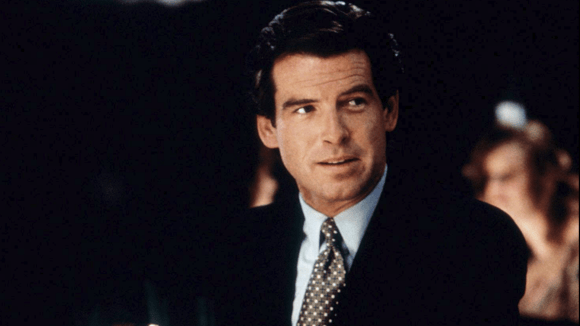
Unfortunately for Daniel, Miranda has moved onto a new beau, Stuart “Stu” Dunmeyer, played by the super hot Pierce Brosnan. Sorry Robin Williams fans, as awesome as he was, he does not compete with Pierce Brosnan in the looks department–get it, Sally Field! There is a funny scene where Stu takes Miranda and the kids to the country club to swim. Depressed at the sight of seeing another man romancing his estranged wife and children, Mrs. Doubtfire downs drinks at the bar. At one point, after hearing a rude remark made about him by Stu, he throws a lime at the back of Stu’s head, then claims there was a “run-by fruiting” when Stu turns around in anger.
I think the film tries to somewhat portray Stu as a villain for comedic effect. However, he’s not really a villain in the sense that he’s purposely doing anything bad. However, he will be the factor that will ruin Daniel’s chances at reconciliation. While Daniel is trying to improve his life and meet the court requirements for joint custody, what he wants is to be back with his family; however Stu looks like he’ll be blocking that goal. And Stu isn’t just trying to hook up with old flame Miranda. After a business associate makes a comment about Miranda “having baggage” (i.e. three children), Stu corrects him, stating that he’s crazy about Miranda and her children.
The hunky Pierce Brosnan in “Mrs. Doubtfire.”
Daniel’s behavior toward Stu reinforces Miranda’s decision to divorce him, in my opinion. Here is a grown man, who yes, is upset that Stu is taking his place as the patriarch, but he responds by throwing fruit, flipping Stu the bird, stating that Stu achieved his physique with liposuction, pulling the emblem off the hood of Stu’s Mercedes, and then truly takes things too far at Miranda’s birthday dinner. Daniel learns of Stu’s allergy to pepper. Daniel is at the restaurant to attend both a dinner/meeting with his new boss and as Mrs. Doubtfire to celebrate Miranda’s birthday. He ducks into the kitchen, finds Stu’s dinner and sprinkles pepper all over it. Stu is handed his dinner, takes a bite, and immediately starts choking. He is truly at risk of dying and Daniel finally realizes what he’s done and saves Stu’s life via the heimlich maneuver. Unfortunately for Daniel, the jig is up as Mrs. Doubtfire when his prosthetic mask is torn from his face while saving Stu. This brings us to the greatest line in the film:
MIRANDA: Oh my god! Oh my god! The whole time?! The whole time?! THE WHOLE TIME?! I have to go. We have to leave now. We have to go. I have to leave. We have to leave.
Sally Field as Miranda Hillard in “Mrs Doubtfire” (1993).
By the end of the film, I think it’s a pretty safe bet that Miranda and Stu will continue seeing one another. Thankfully, Miranda and Daniel are able to resolve their differences enough that Miranda gives Daniel the housekeeper/nanny job so that he can see his children every day after school. The children can also see their father, via his “Mrs. Doubtfire” persona, which is a new hit children’s show in the local San Francisco market. It would have been easy for the filmmakers to turn Stu into a villain, make him slimy and gross, only wanting to hook up with Miranda for sex, her money, her business, etc. But the film doesn’t do that, Stu is presented as a stand-up guy, and we as the audience aren’t disappointed that Miranda might find a new father for her children. Both she and Daniel are better off in their new arrangement. And Miranda, who at the beginning of the film expressed how unhappy and angry she was in her marriage to Daniel, and how it made her act and feel, will finally get a chance at happiness. She’s found a man who brings what she needs to the table, and we cannot help but root for her and Stu.
When you think of birds in the movies, this image probably comes to mind:
Tippi Hedren in Alfred Hitchock’s “The Birds” (1963). Don’t even get me started on why they chose to run out of the school when the birds started congregating on the jungle gym. Stay inside! I like to think that the birds attacked the children because they were singing that annoying song.
Alfred Hitchock’s 1963 masterpiece, The Birds, tells the story of Bodega Bay, a small town near San Francisco, California that is dealing with violent and random bird attacks. Crows are inexplicably attacking people in their homes, in phone booths, outside, anywhere. The film never explains why the birds are attacking. Hitchock purposely eschewed the use of music in the film. The only sounds we hear aside from dialogue and natural sounds from the actions in the film are the sounds of the birds crowing. Each time the birds appear onscreen, we know that another attack is about to happen. The film ends with no resolution. In Bodega Bay, the birds are still out there and are to be feared.
In The Birds, there are two birds featured in the film who are not to be feared–the lovebirds that Rob Taylor wants to purchase from Tippi Hedren (who doesn’t actually work at the bird shop, but is shopping for a cage for her myna bird). People who own lovebirds typically purchase them in pairs, as a pair of lovebirds will bond for life. A solitary lovebird who doesn’t have a constant companion will be very sad. Owners can own just one lovebird, but they should be prepared to spend a lot of time with their bird. In The Birds, I believe that these lovebirds represent Taylor and Hedren’s characters.
Hedren’s character is a bit of a wild woman who somewhat lives in a gilded cage. She’s basically a rich socialite with little regard for others. Due to her behavior and attitude, she’s somewhat trapped by her lifestyle. The only reason she goes to Bodega Bay initially, is to use the lovebirds as a means to pursue Taylor. She’s rich and isn’t used to not getting what she wants. Taylor makes it clear to Hedren in the pet shop that she’s not interested in people of her type.
Lovebirds may represent the antithesis to the other birds in the film. Birds don’t have to be evil or be killers–they can be sweet, wonderful companions for humans and other birds. The lovebirds in The Birds demonstrate that maybe humanity and nature can restore harmony soon.
The lovebirds in “The Birds.” I believe these are “rosy-faced lovebirds.”
Aside from the birds in The Birds, there are other ways birds are represented in film:
COMPANIONS
Iago the Scarlet Macaw parrot in Aladdin, while an evil bird, he is a wiseacre and says what’s on his mind regardless of whether he’s talking to his master, Jafar, or mocking the Sultan.
Kevin in Up is a goofy bird and the comic relief of the film. Kevin is a made-up tropical bird who helps Carl and Russell make it to Victoria Falls. Kevin also provides the conflict of the film. Famed aviator Charles Muntz has been looking for Kevin’s species for years. Kevin is like many real birds in that when she (yes “she”) feels that someone is a friend, she will be kind and loyal. However, if she senses someone is a threat, or that person was mean to her, she’ll be hostile and combative. Also, like real birds, Kevin is very curious and gets into everything.
Hedwig in the Harry Potter series is Harry Potter’s loyal owl. She is a constant companion for Harry through all of his adventures. She would deliver Harry’s mail, but was also a faithful friend. Hedwig also demonstrated how smart and clever birds can be.
Zazu in The Lion King. Zazu is a hornbill who is not only Mufasa’s personal assistant and adviser, but he also takes care of Simba after Mufasa’s tragic death. Zazu’s allegiance is partially out of duty to the kingdom, but I also feel that he feels a sense of loyalty to the deceased Mufasa. Zazu also doesn’t want to see Scar in charge.
Maleficent’s black crow, who I don’t believe has a name, is as evil as evil gets. He keeps Maleficent informed on the goings on in the fairies’ cottage and is the first one to inform Maleficent of Princess Aurora’s location when he spies magic coming up through the fairies’ chimney.
Iago from “Aladdin” (1992)
WISDOM
Owl in Winnie the Pooh dispenses advise to Winnie the Pooh and the other residents of the Hundred Acre Woods.
Scuttle in The Little Mermaid, while definitely not smart like Owl, he lives above the sea and regularly watches and interacts with the humans. Mermaid Ariel, who desperately wants to live out of the sea meets up with Scuttle, often bringing objects from the ocean floor that she has found. She asks Scuttle as to what the objects are. While Scuttle is usually wrong (e.g. telling Ariel that a dinner fork is a “dinglehopper” and is used to comb her hair), he is very kind and tries to keep Ariel informed about what’s going on above the sea.
“Owl” from “The Many Adventures of Winnie the Pooh” (1977)
SYMBOLISM
In The Maltese Falcon (1941) John Huston’s directorial debut and the first film noir, stars Humphrey Bogart as Sam Spade. While investigating the murder of his partner, Miles Archer, Bogart gets involved with a cast of characters who not only have something to do with Archer’s death, but who are searching for the elusive Maltese Falcon statue. This bejeweled statue has traveled the world and is apparently worth tens of thousands of dollars. When the statue is finally found, it is determined to be a fake. The criminals are angry and frustrated, but seek to continue looking for it. While holding the fake statue, a detective asks Bogart, “Heavy? What is it?” Bogart says, “The, uh, stuff that dreams are made of.” This faux bird represents the lack of loyalty the criminals displayed to one another during their journey. A bird, when treated with love and kindness, can be a loyal and generous friend. They’ll be by your side constantly and will give affection. They’ll also give you their dinner if you don’t pay attention, they want to make sure you eat. The criminals are so shady in this film, that they don’t deserve to succeed at the end.
There is much bird imagery in Psycho. It is mostly used in the scene between Norman (Anthony Perkins) and Marion (Janet Leigh) in the motel office. The birds in these scenes foreshadow Norman’s psyche and Marion’s eventual fate. Norman has a variety of stuffed birds: everything from the predator hawk to a small songbird. Norman mentions to Marion Crane (his eventual victim) that one of his hobbies is “stuffing things” i.e. taxidermy. This foreshadows the fact that he’s been perhaps practicing his taxidermy skills elsewhere, like on his mother’s corpse, for example (granted she is a skeleton, but he’s been preserving her). The birds are creepy as there are a lot of them. One could argue that the different types of birds are representative of the characters in the film. There is an owl and hawk, two predator birds, that are featured prominently on the wall. Norman’s mother is a predator, her personality has completely consumed Norman’s. There are also some small songbirds who represent Marion. These birds would be consumed in no second flat by a predator, just like it doesn’t take long for Marion’s demise at the Bates Motel. Birds are very fragile, just like Norman Bates’ psyche. Women are often presented as fragile and delicate, in which a bird could represent Marion. Norman even tells Marion that she “eats like a bird” as she picks at the bread on her sandwich. Birds actually eat a lot, a fact which Norman even mentions to Marion. There is so much going on in this scene that it would probably warrant its own blog entry.
Birds can also represent a variety of other themes: freedom, the feeling of being trapped, evil, arrogance, and mischievousness.
Norman Bates’ office in the Bates Motel in “Psycho” (1960)
Other favorite birds of mine:
Donald Duck. Look for him in Donald Duck in Mathmagic Land(1959). Perhaps the only good math-related movie ever made.
Daffy Duck. His “Duck Amuck” (1953) cartoon is hilarious.
Woodstock from Peanuts. He doesn’t do much except be Snoopy’s companion, but he has his moments.
Roadrunner. He says so much by saying so little “beep beep” which roughly translates to “ha ha” when said to Wile E. Coyote after successfully evading yet another trap. Why does Wile E. Coyote want to eat him so much anyway? I doubt he’s got that much meat on him.
Piper from the Pixar short. This bird is just so cute!
Piper from Piper (2016) Pixar’s short film. Look at his face!
This post was inspired by my bird, Buddy, a yellow-sided green cheek conure: